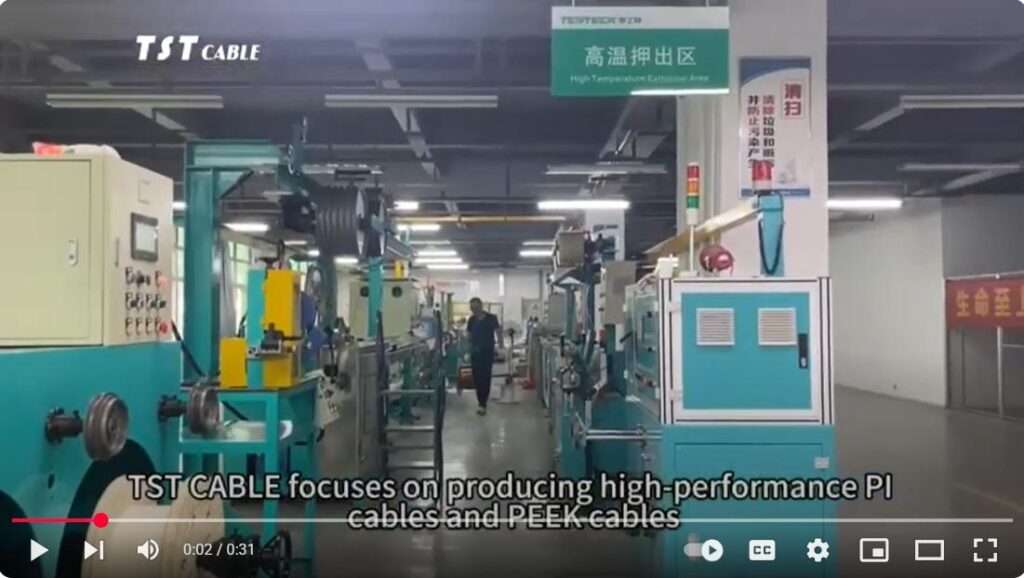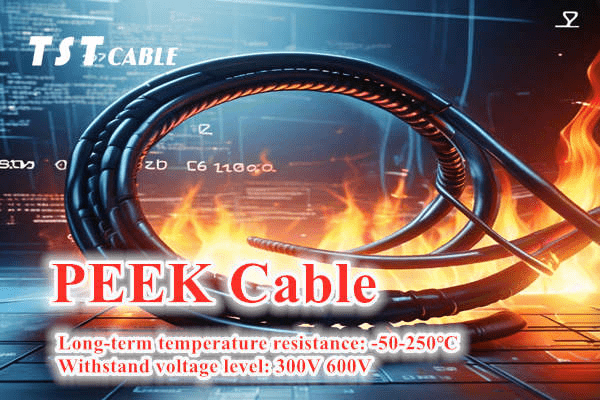

The 800V high-voltage platform has become a technological watershed for high-end new energy vehicles, while traditional high-voltage cables face three major bottlenecks under 800V+ conditions: insulation breakdown, corona corrosion, and thermal management failure. PEEK cables, with their “super plastic” properties, are becoming a key material for improving the reliability of 800V systems. The following is an analysis of the application of TST CAB LE PEEEK cables:
I. Core Challenges of 800V Platform for Cables
| Challenge Type | Pain points of traditional materials | as a result of | TST CABLE PEEK Solution |
| High voltage stress | Insufficient dielectric strength of XLPE/silicone (<20 kV/mm) | Partial discharge → insulation carbonization → breakdown | Dielectric strength ≥25 kV/mm, withstand voltage 2300V+ |
| Corona corrosion | Organic materials are prone to corona discharge at voltages >600V. | Surface powdering, cracking, and a sudden drop in lifespan | Excellent corona resistance, no degradation after 1000 hours |
| Thermal management pressure | Continuous operating temperature ≤150℃ | Insulation softening and deformation under high load | Long-term temperature resistance 260℃, heat distortion temperature >300℃ |
| Lightweight requirements | Copper + traditional insulation is heavy | Range loss (approximately +5km for every 10kg weight reduction) | Density 1.32 g/cm³ (15% lighter than XLPE) |
| Fast charging thermal shock | High coefficient of thermal expansion (>200×10⁻⁶/℃) | Interface stratification after temperature cycling | CTE≈45×10⁻⁶/℃, better matching with copper. |
| Flame Retardant Safety | Halogen materials release toxic gases when burned. | Fire risk + environmental non-compliance | Halogen-free self-extinguishing (UL94 V-0), extremely low smoke emission |
Key data: The peak operating voltage of the 800V system is approximately 1100V. The insulation needs to withstand 2.5 times the safety margin (≥2750V). Traditional materials are at their limit, but PEEK is more than capable.
II. Four Core Application Scenarios of TST CAB LE PEEK Cables in 800V Systems
2.1 Flat wire for motor windings (currently the largest incremental market)
Outer layer: PEEK insulation (thickness 0.08–0.15mm), withstands 2300V+, flame retardant and self-extinguishing.
Conductor: Copper flat wire (rectangular cross-section) with high slot fill factor and excellent heat dissipation.
| Advantages | Traditional enameled wire | TST CAB LE PEEK flat wire | value |
| Pressure resistance | 1500–1800V | 2300V+ | Meets the safety margin of the 800V platform |
| Production process | Multiple coatings and baking (5–8 layers) | Single-layer extrusion | Yield increased by 30%, cost decreased by 20%. |
| Bending reliability | The paint film is prone to cracking (from repeated bending). | High toughness | Automated winding yield increased |
| thermal conductivity | 0.2 W/m·K | 0.35 W/m·K | Heat dissipation efficiency increased by 40% |
| Weight loss effect | benchmark | -15% | Key to Motor Lightweighting |
2.2 High-voltage wiring harness (battery pack → electric drive → OBC)
| Application Location | Traditional solution | PEEK scheme | Advantages |
| Internal connections of the battery pack | XLPE insulated copper busbar | PEEK insulated flexible copper busbar | Withstands 1000V+, bending life increased by 3 times |
| Electric drive high voltage input | Cross-linked polyolefin cables | PEEK insulated shielded cable | Corona resistance, continuous operation at 150℃ |
| OBC/DCDC connection | silicone wire | PEEK thin-walled cable | Wall thickness decreased by 20%, bending radius decreased by 30%. |
| Fast charging cable | TPU protective sleeve | PEEK+TPU composite sheath | Withstands 10,000+ insertion/removal cycles |
Design highlights: PEEK is used as the inner insulation layer and flexible outer sheath (TPU/TPE), which balances high insulation and flexibility.
2.3 Charging gun and liquid-cooled charging cable
| part | PEEK application | value |
| Charging gun plug insulator | PEEK injection molded parts | Withstands 1000V+, flame retardant V-0, and extended insertion/removal life. |
| Internal flow channels of liquid cooling plate | PEEK pipes | Resistant to coolant corrosion, stable from -40 to 150°C |
| Signal line insulation | ultra-fine PEEK thread | High-frequency signal integrity (low dielectric loss) |
| Connector terminal bracket | PEEK structural components | Dimensionally stable at high temperatures, with no creep. |
✅ Case Study: The Porsche Taycan 800V fast charging system uses a PEEK-based insulation solution and supports 350kW supercharging (300km range in 10 minutes).
2.4 Internal Connections of the Electrical Control System
| application | Traditional pain points | PEEK scheme |
| IGBT module connection | Silicone wire high temperature aging | PEEK withstands temperatures up to 200℃ and continuous operation. |
| Current sensor line | High dielectric loss | Low tanδ (0.002@1kHz) |
| High-voltage connection between PCB boards | Space constraints | Thin-walled design (wall thickness 0.3mm) |
III. Comparison of TST CABLE PEEK Cables and Traditional High-Voltage Cables
sheet
| Performance indicators | TST CABLE PEEK | XLPE | silicone | Cross-linked polyolefins | TPU |
| Continuous operating temperature | 260℃ | 125℃ | 180℃ | 150℃ | 105℃ |
| Dielectric strength (kV/mm) | 25–28 | 18–20 | 20–22 | 19–21 | 17–19 |
| Corona resistance (1000h) | No damage | Severe carbonization | Mild degradation | Moderate degradation | Severe deterioration |
| Flame retardancy | UL94 V-0 (Halogen-free) | Flame retardant needs to be added | Self-extinguishing | Flame retardant needs to be added | Flame retardant needs to be added |
| Density (g/cm³) | 1.32 | 0.92 | 1.2 | 0.95 | 1.2 |
| Heat distortion temperature (°C) | >300 | 90 | 200 | 110 | 80 |
| Chemical resistance | Excellent (resistant to coolant/grease) | good | Difference | good | medium |
| Cost (RMB/meter) | 80–150 | 20–40 | 30–60 | 25–50 | 15–30 |
| Applicable voltage platform | 800V+ | ≤400V | ≤600V | ≤600V | ≤400V |
✅ Conclusion: PEEK is irreplaceable in high-voltage, high-heat, and high-reliability scenarios of 800V+, with cost being the main constraint.
IV. Key Technical Parameters and Verification Standards
4.1 Core Performance Indicators (800V Application)
sheet
| parameter | Require | Test Standards | Pass value |
| Rated voltage | 1500V AC / 2000V DC | GB/T 12528 | pass |
| Corona resistance | 1500V, 20kHz, 150℃×1000h | LV215-1 | No breakdown, strength retention ≥80% |
| thermal aging | 200℃×3000h | GB/T 2951.12 | Stretch retention ≥70% |
| Flame retardancy | Vertical combustion | UL 1581 | V-0 (1.5mm) |
| Low temperature bending | -40℃ × 5 times | GB/T 2951.14 | No cracks |
| Coolant resistant | 135℃×1000h | LV214 | No swelling, stable performance |
| Partial discharge | 1.5U₀ | IEC 60270 | ≤5 pC |
4.2 Automotive Industry Certification Requirements
sheet
| Certification | mechanism | Key Requirements | state |
| LV215-1 | German Association of the Automotive Industry | Corona resistance, thermal aging, and chemical compatibility | Required |
| USCAR-21 | Society of Automotive Engineers (SAE) | Mechanical/Environmental/Electrical Reliability | Required |
| ISO 6722-1 | International Organization for Standardization | General requirements for road vehicle cables | Base |
| GB/T 33598 | Chinese national standard | Electric vehicle high voltage cables | Forced |
| CQC Certification | China Quality Certification Center | Safety and performance | Domestic projects are required |
V. Selection and Application Implementation Recommendations
| stage | cycle | Key Actions |
| Scheme Design | January–February | Define voltage/temperature/space requirements and verify through simulation. |
| Sample Development | February–March | Joint design with suppliers, small-batch trial production |
| bench testing | February–March | Corona resistance, thermal aging, and chemical compatibility testing |
| Real vehicle verification | March–June | Vehicle road testing (high and low temperatures, vibration, fast charging cycle) |
| Authentication Acquisition | February–April | LV215/USCAR/CQC and other certifications |
| Batch import | As needed | Establish a quality control system and ensure supply chain security. |
a PEEK Cable Supplier
TST CABLE (automotive grade certified) is preferred .
✅ Process capabilities: Capable of thin-wall extrusion (wall thickness ≤ 0.3mm) and online inspection.
✅ Testing capabilities: Own corona resistance and thermal aging test bench
✅ Success Story: Mass production projects on the 800V platform already exist.
✅ Fully certified: LV215, USCAR, IATF 16949
VI . Future Trend Outlook
sheet
| trend | Driving factors | Influence |
| Voltage platform upgrade | 1000V+ platform development (such as Rivian) | PEEK demand further expands |
| Material composite | PEEK+ nanofiller (thermally/electrically conductive) | Performance improvement and cost optimization |
| Technological innovation | Laser welding replaces crimping | Connection reliability increases, risk of damage decreases. |
| A sound standard system | China Association of Automobile Manufacturers (CAAM) leads the development of PEEK cable standards. | Lower the certification threshold and accelerate its adoption. |
| Cost critical breakthrough | Resin cost in 2026 < 400 yuan/kg | Penetration from high-end models to mainstream models |
| Development of recycling technology | PEEK chemical depolymerization and recycling | Decreased lifecycle costs, improved ESG practices |
Market forecast: China’s demand for PEEK in 800V motors will reach 2,630 tons in 2027. If it is expanded to high-voltage cables for the whole vehicle, the total demand is expected to exceed 5,000 tons/year (global PEEK consumption in 2023 was about 10,000 tons).
The technological inflection point from “optional” to “mandatory”.
The application of TST CAB LE PEEK cables in 800V new energy vehicles
is not “icing on the cake,” but rather “providing timely help.”
✅ Current Value: Solves the insulation reliability pain point of the 800V platform, supporting ultra-fast charging and high power density electric drive.
✅ Long-Term Value: Lightweight design contributes to increased range, while flame retardancy enhances the overall vehicle safety level.
✅ Industry Value: Breakthroughs in domestically produced materials help China achieve technological leadership in new energy vehicles.
TST CAB LE’s recommendations for automotive clients:
High-end models (800V+, ultra-fast charging): Fully adopt PEEK cables (flat wire + high-voltage harness).
Mainstream models (400–800V transition): Pilot projects in key areas (motor flat wire, charging interface). R&
D reserves: Proactively develop PEEK solutions for 1000V+ platforms to seize the technological high ground.
Action Plan: Initiate small-batch sample testing
by engaging with leading suppliers
(focusing on verifying corona resistance and thermal aging)
; participate in industry standard setting to gain technological influence;
and plan a supply chain security strategy (domestic + imported dual backup).
Every leap in voltage level represents a revolution in materials technology.
TST CAB LE PEEK cables are becoming the “hidden champion” leading the way for new energy vehicles in the 800V era.
Also available in:
 English