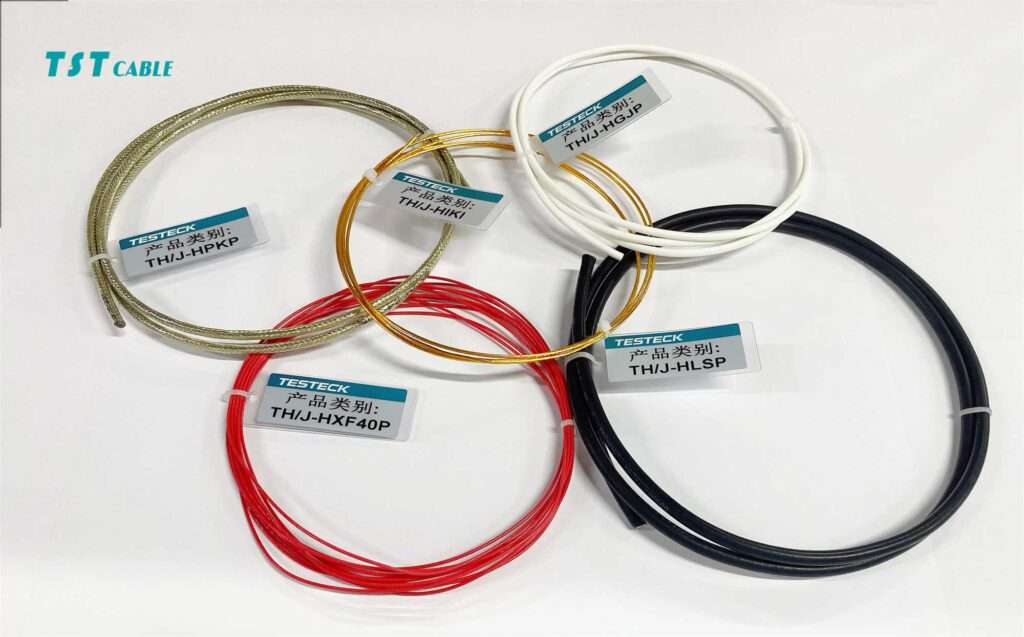


TST CABLE ensures the long-term performance of PEEK (polyetheretherketone) insulated wires throughout the entire lifecycle of a nuclear power plant (typically 40–60 years), a complex undertaking involving materials science, engineering design, manufacturing control, certification verification, and operation and maintenance management. TST cable Nico will now explain this from five key dimensions:
I. Source: TST CABLE uses high-purity, high-stability medical/nuclear-grade PEEK raw materials.
Strict material selection:
Use unfilled, high molecular weight (intrinsic viscosity ≥ 0.8 dL/g) pure PEEK resin (such as Victrex 450G, Solvay KetaSpire KT-880).
The total amount of metal ion impurities (Na⁺, K⁺, Fe³⁺, etc.) is <1 ppm to prevent catalytic degradation under radiation;
Moisture content <0.02% to avoid hydrolysis during extrusion that could break the molecular chains.
Irradiation stability pre-screening:
The raw materials need to pass accelerated gamma irradiation tests (such as 100 Mrad, cobalt-60 source) to confirm that the tensile strength retention rate is >80% and there is no significant discoloration or embrittlement.
II. Design: Structural optimization to match nuclear-grade operating conditions
sheet
| Design Elements | Special requirements for nuclear power | TST CABLE PEEK Cable Solution |
| Insulation thickness | It must meet the IEEE 383 withstand voltage and partial discharge requirements. | Precision extrusion controls tolerance to ±0.02mm to avoid electric field concentration. |
| Conductor selection | High temperature oxidation resistance, low thermal expansion | Nickel-plated copper or alloy conductors (such as MP35N) reduce interfacial stress. |
| air gap-free structure | Preventing insulation breakdown caused by vapor penetration under LOCA conditions | Single-layer extruded PEEK is dense and non-porous, superior to wrapping + impregnation processes. |
| Shielding design | Immunity to electromagnetic interference (such as CRDM pulse noise) | Silver-plated copper wire braid + PEEK outer sheath, combining flexibility and shielding. |
✅ Key point: Avoid using fillers such as glass fiber and mica – although they improve temperature resistance, they are prone to moisture absorption and powdering after irradiation, which reduces reliability.
III. Manufacturing: Controlled and Clean Production Throughout the Entire Process
Specialized high-temperature extrusion line:
Temperature control accuracy ±1℃ (PEEK melting point 343℃, degradation temperature >500℃, narrow temperature window);
Nitrogen protection prevents high-temperature oxidation;
Online eccentricity meter + spark test, 100% detection of insulation defects.
TST CABLE Cleanroom Environment:
ISO Class 8 (100,000 level) and above, controlling dust and ion pollution;
Finished products are vacuum-packed to prevent moisture and dust.
Traceability:
Each roll of yarn is labeled with the batch number, extrusion parameters, and raw material LOT number, enabling full lifecycle traceability.
IV. Verification: Passed rigorous nuclear-grade qualification tests
For example: IEEE 323 + IEEE 383 combined certification must be completed, and the core items include:
sheet
| Test type | Conditional Example | Qualification Standard |
| thermal aging | 150℃ × 90 days (equivalent to 40 years) | Insulation resistance >10⁹ Ω, no cracks |
| Gamma irradiation | 100 Mrad (Cobalt-60, room temperature) | Tensile strength retention ≥75% |
| LOCA simulation | 170℃, 0.4 MPa steam × 30 days | Dielectric strength >15 kV/mm, no bulging/carbonization |
| Vibration + Thermal Cycling | 5–50 Hz, 2g ±10℃~120℃×100 cycles | Continuous conduction, no fretting wear |
| Flame retardant and toxicity | IEC 60332-3 Class A + IEC 60754 | Light transmittance ≥60%, halogen acid gas ≤5 mg/g |
�� Note: Do not rely solely on the material data sheet; a full cable test must be conducted on the finished cable.
V. Operation and Maintenance: Installation Specifications and Status Monitoring
Installation requirements:
Bending radius ≥8×D (to avoid micro-cracks in the insulation layer);
Avoid contact with sharp metals; use PEEK or PTFE padding.
The joint is sealed with laser welding and PEEK heat shrink tubing to prevent moisture intrusion.
On-duty inspection:
Regular infrared thermal imaging is used to monitor abnormal temperature rises.
Insulation resistance test (>1 GΩ @ 100℃);
The radiation dose is tracked cumulatively, and a warning is issued to replace it when it approaches the lifespan threshold.
Spare parts management:
Store in a dry (RH<50%), light-protected environment, and avoid long-term pressure and deformation.
Stability and reliability are not only achieved through design and development , but also through time, market validation, and production management .
In the nuclear power field, “theoretically feasible” is far from enough; “absolutely foolproof in practice” is the bottom line.
The long-term performance guarantee of PEEK insulated wire
is not a victory of a single material,
but the result of precise coordination among five major links: materials, design, manufacturing, verification, and operation and maintenance.
TST CABLE takes nuclear safety culture as its foundation and
treats every meter of PEEK line as a “safety-grade component”—because
it knows that deep inside the reactor,
time will test everything, and safety will never give you a second chance.
Also available in:
 English