
—Aerospace-grade solutions for high temperature, high vibration, and high reliability
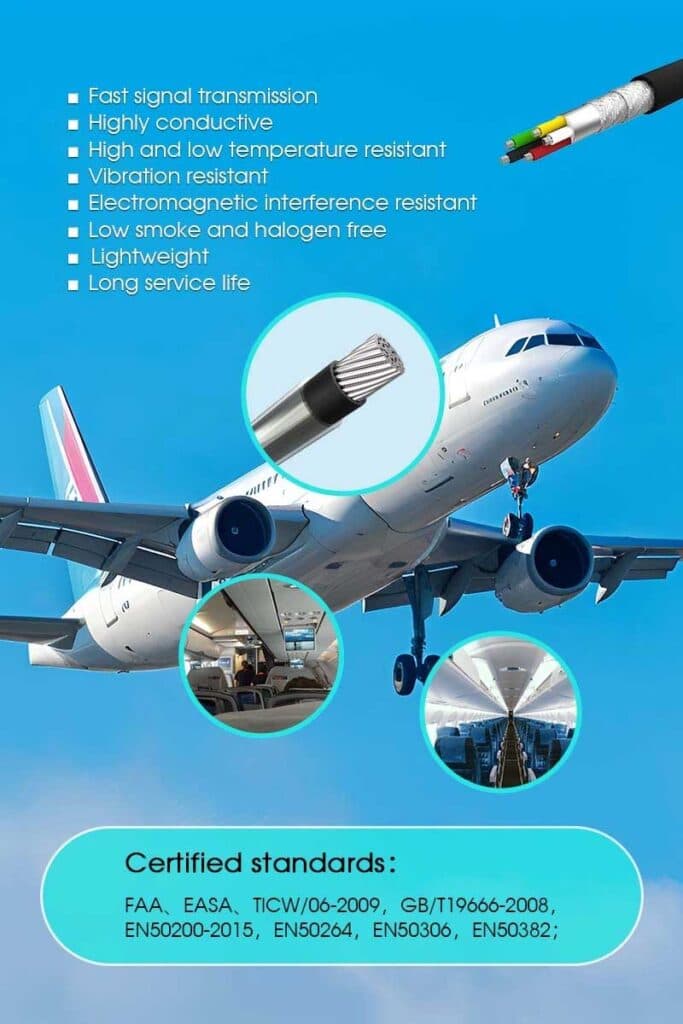
Aircraft engines are the “crown jewel of industry,” and their sensor cables must operate stably for tens of thousands of hours in extreme environments characterized by continuous high temperatures of 250–300°C, high-frequency vibration, chemical corrosion, and electromagnetic interference. TST CABLE PEEK cables, with their unique performance combination, have become the preferred solution for sensor cables in the high-temperature regions of modern aero-engines. Nico reveals the answers to the questions of what applications and value TST CABLE PEEK cables offer .
I. The “Hellish” Operating Conditions of Engine Sensor Cables
| Challenge Type | Specific parameters | Traditional material failure modes | TST CABLE PEEK response value |
| Sustained high temperature | Combustion chamber outlet: 250–300℃; Turbine zone: 200–280℃ | Silicone aging and cracking (>180℃); PTFE cold flow deformation. | Stable operation at 250℃ continuously, and no damage at 300℃ for short periods. |
| High frequency vibration | 50–5000 Hz, acceleration >20G | Glass fiber insulation fragmentation and metal shielding layer fatigue fracture | High fatigue strength (no damage after 10⁷ cycles) |
| Chemical erosion | Aviation kerosene, lubricating oil, hydraulic oil, de-icing fluid | Ordinary plastics swell and their insulation deteriorates. | Fully chemically inert (ASTM D471 certified) |
| Weight sensitive | Every 1kg of weight loss is approximately equivalent to saving 300kg of fuel per year. | The metal sheath is too heavy | Density 1.32 g/cm³ (80% lighter than metal) |
| Signal accuracy | microvolt thermocouple signal | High dielectric loss leads to signal attenuation | Low tanδ (<0.002@1kHz) |
| Safety requirements | FAR 25.853 (Flame retardant/Low smoke/Non-toxic) | Halogen materials release toxic gases when burned. | UL94 V-0, smoke density <50 (NBS test) |
Key data: A single modern high-bypass turbofan engine (such as LEAP and Trent XWB) contains 200–300 sensors, with a total cable length of over 50 meters, 30% of which is located in the 200℃+ high-temperature zone—this is the core application area of PEEK.
II. Typical Application Scenarios of PEEK Cables in Engine Sensors
Core high-temperature zone sensor (main application of PEEK cable)
| Table sensor type | Installation location | Environmental parameters | Value of PEEK Cables |
| Turbine inlet temperature sensor (TET) | Combustion chamber outlet, before the first stage turbine | 280–320℃ (peak), high vibration | Alternative to fiberglass: Avoid debris contamination of turbine blades |
| Lubricating oil system sensors | Oil pump/bearing cavity | Immersion in lubricating oil at 180–220℃ | Resistant to lubricating oil corrosion, insulation resistance >100MΩ (200℃) |
| Vibration monitoring accelerometer | Bearing housing, rotor support | Vibration 10–2000 Hz, 200℃ | High fatigue strength, zero signal transmission distortion |
| Fuel metering sensor | Near the fuel control unit | Fuel vapor, 150–200℃ | Resistant to fuel penetration, preventing insulation degradation |
| Exhaust Temperature Sensor (EGT) | Low-pressure turbine outlet | 200–250℃, airflow impact | Dimensionally stable (CTE≈45×10⁻⁶/℃), no thermal drift |
Replenishment application in non-high temperature areas
Wire harness sheath: PEEK braided sheath protects traditional cables (weight reduction + abrasion resistance)
Connector insulator: PEEK injection molded connector (10,000+ mating cycles)
Shielding layer substrate: PEEK film as shielding layer support (lightweight).
III. TST CABLE PEEK vs Traditional Aviation Cable Materials: Why PEEK Cable ?
sheet
| Material | Temperature resistance (°C) | Vibration tolerance | weight | Chemical tolerance | Aviation Certification | Applicable Areas |
| PEEK | 250 (continuous) | Excellent | lightest | Full tolerance | AS22759/EN3435 | Combustion chamber/turbo zone (core) |
| Polyimide (PI) | 260 | Brittle (easily broken) | middle | good | Partial certification | Non-vibration zone (use with caution) |
| Fiberglass | 400+ | Poor (risk of debris) | middle | Difference | Traditional solution | Phase out (due to pollution risk) |
| PTFE | 260 | Poor (cold flow deformation) | middle | Excellent | Wide Certification | Low temperature zone (<200℃) |
| silicone | 180 | good | light | middle | Wide Certification | Fan/Low-Pressure Compressor Area |
✅ The irreplaceable nature of TST CABLE PEEK:
The only system to simultaneously meet the following requirements: 250℃+ continuous operation + high vibration tolerance + no risk of debris + lightweight.
Safety upgrade: Fiberglass insulation can generate micro-debris under vibration, which may enter the airflow and damage turbine blades (FAA has warned).
Life matching: Design life ≥ 20,000 flight hours, synchronized with engine overhaul cycle.
IV. Typical Structural Design of TST CABLE PEEK Sensor Cables
Key design parameters:
Bending radius: ≥6×D (to avoid micro-cracks in insulation)
Shielding coverage: ≥95% (meets DO-160 Section 20 EMI requirements)
Insulation eccentricity: <8% (laser online monitoring)
Connector compatibility: MIL-DTL-38999 III series high-temperature connector (termination process: laser welding)
V. Aviation Certification and Testing Standards (Hard Thresholds)
Core Certification System
| Authentication type | standard | Key Requirements | Verification method |
| Materials Certification | AMS 3651 | Heat aging (250℃×3000h, strength retention ≥70%) | Thermogravimetric analysis + mechanical testing |
| Cable Certification | AS22759 / EN 3435 | High and low temperature cycling (-55℃↔+250℃×500 times) | Environmental test chamber |
| Fire safety | FAR 25.853 | Vertical combustion self-extinguishing, smoke density <200 (NBS) | Smoke density tester |
| Fluid tolerance | ASTM D471 | No swelling after soaking in aviation kerosene/lubricating oil for 1000 hours. | Volume change rate <5% |
| Vibration test | DO-160 Section 7 | 20G, 10–2000Hz sweep frequency × 4h | Vibration table + signal monitoring |
| Manufacturer System | Nadcap AC7101 | Special process (extrusion/termination) certification | Third-party audit |
VI. Practical Application Cases and Value Quantification
| project | Application details | Value Results |
| CFM LEAP engine (A320neo/B737MAX) | Vibration monitoring system sensor cables | Weight reduction of 12%, failure rate decreased by 40% (compared to fiberglass solutions) |
| Rolls-Royce Trent XWB (A350) | Turbine front temperature sensor cable | Eliminates the risk of glass shards and extends maintenance intervals to 15,000 flight hours. |
| China Yangtze Engine (CJ-1000A) | Verification of domestically produced PEEK cable hangers | After 2000 hours of bench testing, the insulation resistance remained >80MΩ (250℃). |
| F135 engine (F-35 fighter jet) | High-temperature sensor cables | Weight reduced by 15%, thrust-to-weight ratio improved (significant military value). |
Economic Verification:
Using PEEK cables per engine increases the cost by approximately $8,000–$12,000, but:
Weight reduction of 1.5kg → Fuel savings of $45,000+ over the entire lifespan.
Reduced failure rate → 30% reduction in maintenance costs (cost per unplanned downtime > $200,000)
Return on investment (ROI) > 300% (based on 20,000 flight hours)
VII. Technological Challenges and Cutting-Edge Solutions
| challenge | Innovative solutions | progress |
| High cost (2-3 times that of traditional cables) | Breakthrough in domestically produced resin ( TST CABLE aerospace-grade PEEK) | The price has dropped to $600/kg (imported $1,200/kg). |
| Termination reliability | Laser welding replaces mechanical crimping | Interface strength increased by 50%, vibration failure rate reduced to zero. |
| heat dissipation bottleneck | Nano-AlN filled PEEK (thermal conductivity increased to 1.5 W/m·K) | Laboratory verification, trial production in 2026 |
| Intelligent monitoring | Real-time temperature measurement using integrated fiber Bragg gratings (FBG) | Rolls-Royce is collaborating with Oxford Sensors on development. |
| Supply chain security | China’s “Two Engines Special Project” supports domestic substitution. | TST cables pass bench testing. |
VIII. TST CABLE PEek Cable Maintenance and Life Management Guide
| project | Require | Detection methods |
| Design life | ≥20,000 flight hours | accelerated aging of test benches |
| Regular inspection | Every 5,000 flight hours | Visual inspection (cracks/discoloration) + insulation resistance test |
| Change threshold | Insulation resistance <50MΩ (250℃) or physical damage | High-temperature megohmmeter + endoscope |
| Storage Specifications | Nitrogen packaging, -10~30℃ | Avoid moisture absorption (PEEK moisture absorption rate <0.3%) |
| Installation Taboos | Avoid bending sharp edges and fix resonance points. | Using PEEK clamps, bending radius ≥6D |
IX. Future Trends: Evolution of PEEK Cables for Next-Generation Aero Engines by TST CABLE
Ultra-high temperature compatibility:
For supersonic passenger aircraft (Boom Overture) engines with a temperature requirement of >350℃
Development of PEEK/PI blends (short-term temperature resistance improvement to 320℃)
Intelligent cable integration:
PEEK substrate embedded with FBG sensor for real-time monitoring of cable temperature/strain
Direct data connection to Engine Health Management (EHM)
Breakthrough in Additive Manufacturing:
PEEK powder laser sintering (SLS) directly forms complex connectors.
Reduce interfaces to improve reliability (Airbus has already conducted verification).
Domestic production is accelerating:
China’s “Two Engines Special Project” promotes independent development of the entire PEEK cable supply chain.
Achieve application of C929 wide-body passenger aircraft by 2027
Aviation safety is of utmost importance; material selection is a matter of responsibility.
Near the 250°C flames of an engine, the failure of a single sensor cable could ground an aircraft worth hundreds of millions of dollars.
TST CABLE PEEK cables in aircraft engine sensor wiring represents a perfect fusion of materials science, aerospace engineering, and safety philosophy:
Performance: The only cable to simultaneously conquer the triple limits of high temperature, vibration, and chemical stress
Safety: Eliminates the risk of glass fragmentation, protecting turbine blade safety.
Economics: Lightweight design and long lifespan lead to optimized life-cycle costs.
Strategic: Domestic substitution breaks through bottlenecks, supporting the independent development of large aircraft.
As the LEAP engine cruises smoothly at an altitude of 10,000 meters, and
as the C919’s sensors transmit precise data back to the cockpit,
behind it all is the silent and steadfast protection of the TST CABLE PEEK cable amidst flames and vibrations.
TST CABLE recommends:
OEMs/engine manufacturers: Incorporating PEEK cables into standard configurations for high-temperature sensors.
Cable suppliers: Accelerating AS22759/EN3435 certification and developing domestic alternatives
Maintenance Unit: Establish a specific inspection procedure for PEEK cables and extend engine on-wing time.
The reliability of every cable reflects a reverence for life.
Also available in:
 English