
Polyetheretherketone (PEEK) high-temperature insulated wire, with its superior high-temperature resistance, excellent radiation resistance, outstanding mechanical strength, and inherent flame-retardant properties, has become the preferred solution for high-reliability electrical connections in extremely harsh environments such as nuclear power plants and aerospace. It is not an ordinary wire, but a special functional material carrier that ensures the stable operation of critical systems even at the “edge of limits.”
- Why has TST CABLE PEEK become the “King of Insulation” in extreme environments?
| Performance Indicators | TST CABLE PEEK Material Performance: | Comparison of traditional materials (such as PTFE, silicone, PVC): |
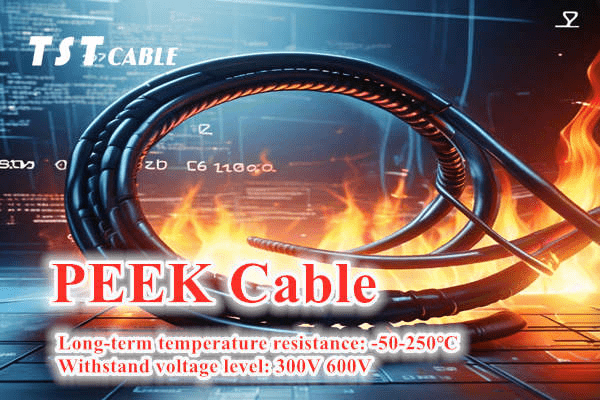
| Continuous Operating Temperature | -60℃ ~ +250℃ (short-term up to 300℃) | PTFE: 260℃ but prone to cold flow; Silicone: 180℃; PVC: <105℃ |
| Ionizing Radiation Resistance | Withstands >100 Mrad (gamma rays) without significant degradation | PVC/silicone becomes brittle and cracks after 10–50 mrad. |
| Flame Retardancy | UL94 V-0, halogen-free, low-smoke, self-extinguishing | Halogen-containing materials release toxic gases when burned. |
| Mechanical Strength | Tensile strength >90 MPa, abrasion-resistant, creep-resistant | PTFE is soft and easily deformed; silicone has low strength. |
| Chemical Stability | Resistant to strong acids, strong alkalis, aviation fuels, and hydraulic oils | Silicone is easily swollen by hydrocarbons. |
| Dielectric Properties | Dielectric constant ≈3.2 (1 MHz), low loss, high-frequency stability | Some engineering plastics experience a significant increase in losses at high frequencies. |
✅ Core Advantages: TST CABLE PEEK maintains long-term insulation integrity under multiple stress coupling conditions including high temperature, radiation, chemical corrosion, and high voltage—an uncompromising requirement for nuclear power and aerospace missions.
II. Nuclear Power Applications: Protecting the Reactor’s “Nerve Endings”
In nuclear power plants, especially in safety-grade (Class 1E) systems, cable failure can trigger reactor shutdowns or even safety accidents. PEEK insulated wires are used for:
In-core Instrument Leads: Connecting core temperature and neutron flux sensors, directly exposed to high-flux neutron and gamma radiation fields, requiring a lifespan of ≥40 years;
Control Rod Drive Mechanism (CRDM) Coil Leads: Withstanding frequent electromagnetic shocks and high-temperature steam environments, PEEK provides high dielectric strength and corona resistance;
Containment Penetration Wiring: Maintaining insulation performance under LOCA (Loss-of-Coolant Accident) conditions (170℃, 0.4 MPa steam);
Spent Fuel Pool Monitoring Systems: Prolonged immersion in boron-containing water and radiation environments highlights PEEK’s hydrolysis resistance and radiation resistance advantages. Certification Requirements: Must meet IEEE 323/IEEE 383 (nuclear-grade equipment qualification), RCC-E (French nuclear power standard), or ASME NQA-1.
III. Aerospace Applications: From Engines to Deep Space Exploration
In aircraft, weight reduction, reliability, and resistance to extreme temperatures are core requirements. PEEK insulated wires are widely used in:
Aircraft Engine Control Systems (FADEC): Located near the turbine section (>200℃), replacing traditional fiberglass braided wires, reducing weight by 30% and resisting vibration fatigue;
Airborne Radar and Electronic Warfare Systems: High-frequency signal transmission requires low dielectric loss; PEEK-based coaxial cables ensure signal integrity;
Satellites and Deep Space Exploration: Resistant to cosmic rays and atomic oxygen corrosion, without cracking during thermal cycling from -100℃ to +200℃;
Electric Vertical Take-Off and Landing (eVTOL) High-Voltage Busbars: Under 800V platforms, PEEK provides high CTI (compared to tracking index >600V) and lightweight insulation.
✅ Typical Standards: MIL-W-22759/86 (US Military Standard), EN 3438 (Airbus), SAE AS22759.
IV. TST CABLE PEEK Cable Product Structure and Manufacturing Process
Conductor: Silver-plated copper, nickel-clad copper, or alloy wire (improves high-temperature oxidation resistance);
Insulation: Single-layer extruded PEEK (wall thickness 0.1–0.5mm);
Or PEEK wrapping + sintering, for ultra-fine wire diameters (<0.2mm);
Shielding (optional): Silver-plated copper wire braid, coverage ≥90%;
Outer Sheath: Can be layered with PTFE or fluorinated ethylene propylene (FEP) to improve lubricity.
Process Challenges: PEEK has a high melting point of 343℃, requiring specialized high-temperature extrusion equipment and precise temperature control to prevent degradation.
V. Advantages of TST CABLE PEEK High-Temperature Insulated Wire
✅ Full range of nuclear-grade certifications: Passed IEEE 323 thermal aging + irradiation + LOCA tests;
✅ Aerospace compatibility: Compliant with MIL, EN, and SAE standards, supporting the AS9100 quality system;
✅ Ultra-fine wire diameter capability: Minimum conductor diameter 0.01mm, suitable for micro-sensors;
✅ Customized services: Color coding, double insulation, integrated fiber optic composite cable;
✅ Domestic substitution breakthrough: Breaking the European and American monopoly, reducing delivery cycle by 50%.
At the forefront of human technological exploration, the reliability of quality is uncompromising.
Whether it’s a nuclear reactor pressure vessel hundreds of meters deep,
or a jet engine at tens of thousands of meters altitude,
or a probe heading to Mars—
TST CABLE PEEK high-temperature insulated wire, with molecular-level stability,
protects every energy transmission and every command delivery.
We not only make “usable” cables, but also ultimate insulation solutions for “zero-tolerance” scenarios.
Because in the world of nuclear power and aerospace, failure is never an option.
Also available in:
 English