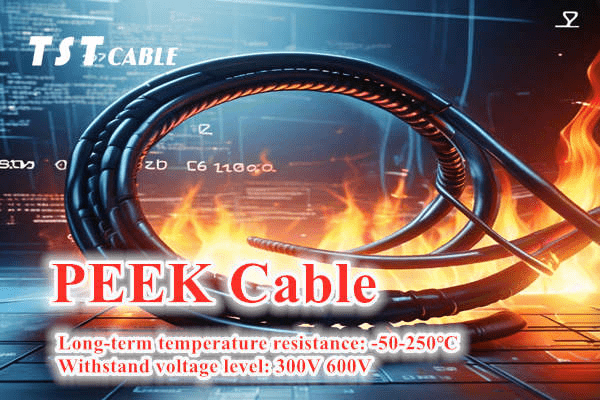

PEEK (polyetheretherketone) insulated wire is considered the “ceiling” of insulation materials in high-end engineering fields, with its comprehensive performance far exceeding that of traditional insulation materials. TST CABLE Nico will systematically compare the core advantages of PEEK with common insulation materials (such as PVC, silicone, PTFE, cross-linked polyolefins, and mica/glass fiber composites) from six dimensions: temperature resistance, mechanical strength, chemical stability, electrical performance, safety and environmental protection, and adaptability to special environments.
I. Comparison Table of Comprehensive Properties of 6 Commonly Used Materials
| Performance indicators | PEEK | PVC | silicone | PTFE | Cross-linked polyolefin (XLPO) | Mica + Fiberglass |
| Continuous operating temperature | -60℃ ~ +250℃ | -40~105℃ | -60~180℃ | -200~260℃ | -40~150℃ | 200~500℃ (but brittle) |
| Short-term peak temperature | 300℃ | 130℃ | 200℃ | 280℃ | 180℃ | 600℃ (but prone to pulverization) |
| Tensile strength (MPa) | 90–100 | 15–25 | 6–10 | 20–30 | 10–20 | Extremely low (substrate dependence) |
| abrasion resistance | Excellent (self-lubricating) | Difference | middle | excellent | middle | Poor (fibers easily detach) |
| Radiation resistance (gamma) | >100 Mrad (Stable) | <10 Mrad | 20–50 Mrad | 50–80 Mrad | <30 Mrad | Medium (but the adhesive is aging). |
| Dielectric strength (kV/mm) | 20–25 | 15–20 | 18–22 | 18–20 | 18–22 | 15–18 (Porous structure) |
| CTI (compared to tracking) | >600 V | 100–200 V | 200–400 V | 150–300 V | 250–400 V | >600 V (but decreases after absorbing moisture) |
| Flame retardancy | UL94 V-0, halogen-free, low smoke | Flame retardant needs to be added | Self-extinguishing | Non-flammable but molten droplets | Available up to V-0 (halogenated/halogen-free) | non-flammable |
| Chemical resistance | Resistant to strong acids, alkalis, oils, and solvents | Resistant to weak acids and alkalis | Water resistant, but not resistant to hydrocarbons | Resistant to almost all | Resistant to common chemicals | High temperature resistant, but not resistant to HF acid. |
| Biocompatibility | ISO 10993 certification | Risk of plasticizers | excellent | excellent | generally | not applicable |
| Processability | High-temperature extrusion (requires specialized equipment) | easy | easy | Sintering/Dispersion | easy | Manual wrapping is inefficient. |
II. Detailed Explanation of the Core Advantages of TST CABLE PEEK Cable
1. True “wide temperature range stability”
Although PTFE is resistant to high temperatures, it becomes brittle and easily deforms when cooled at low temperatures.
Silicone hardens and cracks at high temperatures and is easily swollen by fuel/hydraulic oil;
PEEK maintains high strength and stable elastic modulus throughout the temperature range of -60℃ to 250℃, making it suitable for severe thermal cycling scenarios (such as spacecraft and motor start-up and shutdown).
2. Achieving both mechanical and electrical performance
Mica/glass fiber has high temperature resistance, but it is brittle, heavy, and difficult to bend, and its porous structure makes it prone to moisture absorption, which leads to a decrease in insulation.
PEEK can be extruded into a dense, gapless insulating layer that combines high dielectric strength and bending resistance, making it suitable for micro-wires and dynamic applications.
3. Reliability under extreme environments
Under coupled stresses such as nuclear radiation, plasma, deep-sea high pressure, and high-frequency electric fields,
the PEEK molecular chain structure remains stable, does not release harmful gases, and does not degrade significantly, while silicone/PVC ages rapidly.
4. Meets both safety and environmental protection standards
It achieves V-0 flame retardancy without the need for halogenated flame retardants, produces low smoke density and no corrosive gases during combustion,
and meets the stringent “life safety” requirements of nuclear power, rail transportation, medical and other industries.
5. Long-term cost advantages
Although the initial cost is high, the lifespan can be 2-3 times that of traditional materials, reducing replacement, downtime and maintenance costs.
Its value is particularly evident in “unrepairable” or “high failure cost” scenarios (such as implantation in equipment, satellites, and reactors).
III. Selection Recommendations for Typical PEEK Cable Applications
| Application scenarios | Recommended materials | reason |
| Nuclear power plant CRDM coil leads | PEEK | Radiation resistance + high temperature resistance + high reliability |
| Aircraft engine sensor line | PEEK | Withstands 200℃+ vibration + lightweight |
| Internal lines of medical sterilization surgical instruments | PEEK | Re-sterilizable + biocompatible + non-magnetic |
| Standard building wiring | PVC/XLPO | Cost-sensitive, environmentally mild |
| High-frequency coaxial cable (radar) | PTFE | Lower dielectric constant (2.1 vs PEEK 3.2) |
| Low-cost flexible connector | silicone | Soft and inexpensive, suitable for non-critical applications |
PTFE excels in high frequency, silicone in softness, mica in extreme temperature resistance,
while PEEK excels in being an all-rounder with no weaknesses.
Not “the best,” but “the most balanced and ultimate.”
PEEK insulated wire is not the best in every single aspect,
but it achieves a near-perfect balance between high temperature, strength, insulation, safety, and lifespan.
When the application scenario demands “no failure,”
when the system operates under “multiple extreme stresses,” and
when the total lifecycle cost is more important than the initial price—
PEEK is that silent yet steadfast answer.
Also available in:
 English