
The “heart” of electrical equipment—motors, transformers, and high-voltage systems—relies on high-quality “blood vessels”—insulated electromagnetic wires—for stable and efficient operation. Polyimide (PI) insulated copper wire has become the standard for many high-end applications due to its excellent high-temperature resistance and high insulation performance. However, for a long time, wrapped PI copper wire has suffered from several drawbacks due to process limitations, including weak wear resistance, risk of interface delamination, and low efficiency, limiting the energy efficiency and reliability of equipment.
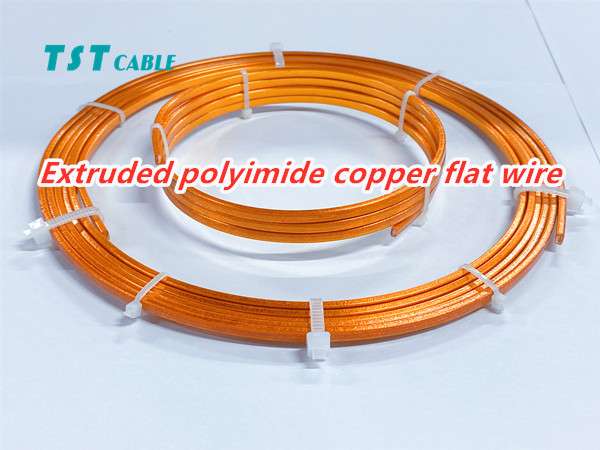
Facing these industry bottlenecks, TST Cable has broken through traditional processes and introduced a new generation of extruded polyimide insulated flat copper wire through innovative melt extrusion technology. It not only inherits the excellent performance of PI material but also achieves a comprehensive leap forward in structure, efficiency, and reliability, becoming a key breakthrough in the upgrading process of electromagnetic wires.
1. Production Efficiency + Structural Revolution, Laying the Foundation for a Leading Position
Traditional Wrapping Process
Extrusion Process
The traditional wrapping process requires winding and bonding multiple layers of PI film onto the conductor surface. This process relies on manual intervention, is limited in speed, and is prone to errors. The extrusion process is completely different:
One-piece molding, molecular-level bonding: The PI resin is melted at high temperature and directly coated onto the conductor, achieving a gapless bond between the insulation layer and the copper conductor, eliminating the micro-gaps and delamination risks caused by adhesives and air residue in the wrapping process.
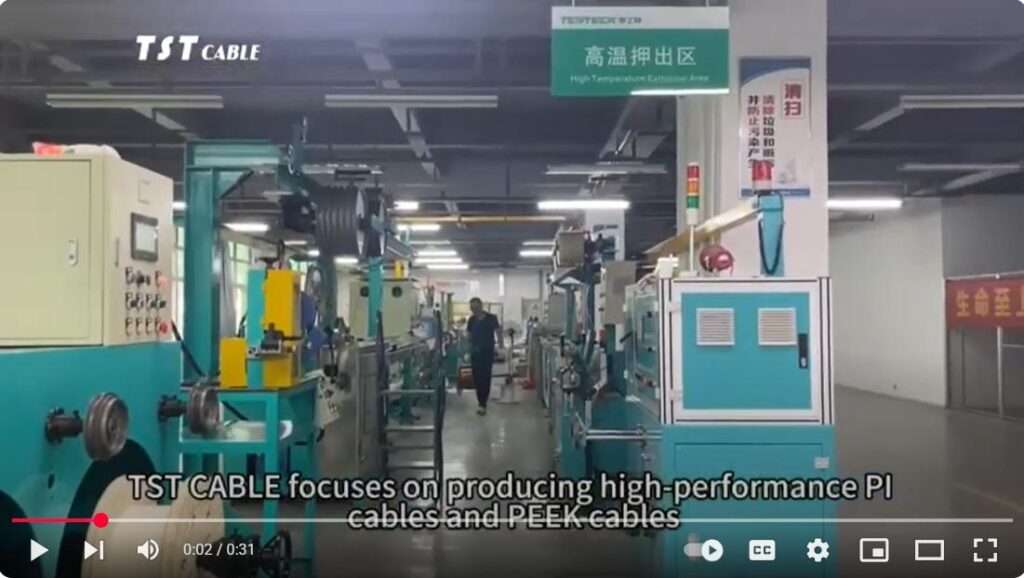
Continuous production, stable and controllable quality: Using a fully automatic extrusion production line, the speed can reach 10-50 m/min, significantly improving production efficiency. The production process is not affected by human factors, resulting in a significantly higher yield rate and ensuring consistency in large-scale supply.
This means that extruded flat copper wire possesses a more stable and reliable physical foundation from the very beginning.
2. Eight Major Performance Advantages, Defining the New Generation of Electromagnetic Wire Standards
Ultra-thin insulation, leap in power density
The insulation layer can be stably made to ≤0.08mm, far lower than wrapped type (usually ≥0.20mm). In the same space, the conductor filling rate is increased by 30%-40%, enabling motors to achieve higher power, lower losses, and reduced temperature rise, making it an ideal choice for 800V high-voltage platforms.
High voltage and corona resistance, fearless of high-voltage challenges
The dense, gap-free structure increases its breakdown voltage by 15%-25%. Nanomaterial modification technology extends its corona resistance life to over 1000 hours (wrapped type is usually <500 hours), with a partial discharge inception voltage (PDIV) of over 1500V, ensuring long-term safe operation under high frequency and high voltage.
Excellent mechanical properties, adaptable to harsh working conditions
Tensile strength exceeds 350MPa, far superior to the wrapped type (approximately 200MPa). The insulation layer does not crack even under 25% tensile deformation, and the bending radius can be as small as 3 times the conductor size, perfectly adapting to high-frequency vibration and compact design requirements.
Wide temperature range adaptability, easily handling extreme conditions
The operating temperature range covers -269℃ to 380℃, capable of handling both cryogenic environments in aerospace applications and continuous operation in high-temperature motors, with a wider application range than the wrapped type (-250℃~260℃).
Dense and tough surface, strong environmental resistance
The high-density insulation layer has a smooth surface, improving scratch and impact resistance by 30%-50%. Excellent chemical resistance extends its lifespan by approximately 20% in harsh environments such as oil and acid/alkali.
Clean and environmentally friendly, meeting special requirements
The material is single and pure, without volatile substances, suitable for applications requiring extremely high cleanliness, such as semiconductor manufacturing and spacecraft vacuum chambers, solving the pollution problems that may be caused by the adhesive layer in wrapped types.
High-frequency stability and low loss
The uniform and dense insulation structure, combined with low dielectric loss characteristics (tanδ<0.02%), effectively reduces dielectric loss and heat generation at high frequencies, ensuring performance stability in high-frequency variable frequency or high-frequency signal transmission.
Superior insulation adhesion
The insulation layer formed under high pressure has extremely strong bonding force with the conductor. Even after severe twisting or bending, it can maintain insulation integrity, eliminating the risk of insulation failure due to deformation. 3. Focusing on Four High-End Scenarios, Demonstrating Irreplaceable Capabilities
New Energy Vehicles | The “Strong Heart” of 800V Electric Drive Systems
Responding to the trend of 800V high-voltage fast charging, extruded PI copper flat wire maintains low partial discharge and low dielectric loss at higher voltages, making it an ideal choice for high-voltage drive motor insulation systems, significantly improving range and system reliability.
Aerospace | The “Survival Expert” in Extreme Environments
Adapting to harsh conditions such as liquid helium low temperatures, strong radiation, and severe vibration, its wide temperature range characteristics, radiation resistance, and high mechanical strength make it a key material for aerospace motors, special transformers, and cryogenic equipment.
Industrial Frequency Conversion and High-Speed Rail Traction | The “Durability Champion” under High-Frequency Vibration
In high-frequency environments driven by high-speed IGBTs, it exhibits outstanding corona resistance and aging resistance, suitable for high-power density and high-vibration scenarios such as traction motors and frequency converters, reducing equipment operation and maintenance costs.
Special Transformers | The “Reliable Guardian” in Extreme Environments
In harsh environments such as shipborne, plateau, and chemical industries, extruded PI insulated copper wire can achieve higher insulation safety margins and structural strength, ensuring the stable operation of special transformers.
4. Long-Term Economic Benefits: Slightly Higher Initial Investment, Significantly Higher Returns
Lower total cost of ownership: Although the initial purchase cost of extruded type is 20%~30% higher than that of wrapped type, its longer service life and near-zero maintenance requirements significantly reduce the overall cost over the entire service life, making it a truly cost-effective choice.
Green manufacturing, energy saving and environmental protection: The extrusion process achieves continuous low-energy consumption production with no exhaust gas or waste emissions, aligning with sustainable development goals and meeting increasingly stringent global environmental regulations.
As electrical systems continue to move towards higher voltage, higher power density, and higher frequency, the performance limitations of wrapped PI copper wire are becoming increasingly apparent. Extruded polyimide insulated flat copper wire, with its integrated molding and dense, gap-free structure, not only achieves a comprehensive improvement in performance but also provides reliable material support for the upgrading of industries such as new energy vehicles, aerospace, and special industrial equipment. By unleashing the potential of materials through innovative processes and driving electrical evolution through structural innovation, TST cable has not only achieved a technological breakthrough but also provided a clear response to the future direction of electrical development.
Also available in:
 English