
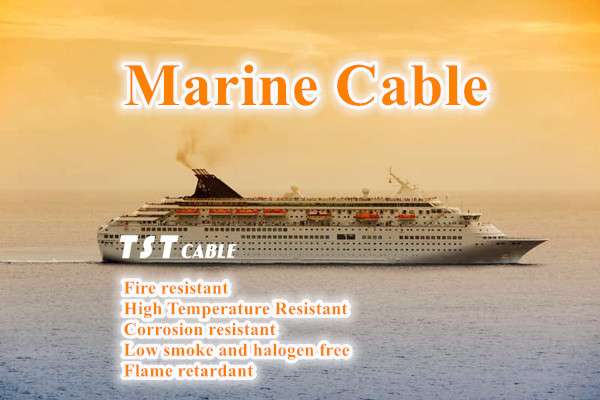
Marine cables are core components of a ship’s power, lighting, communication, control, and automation systems, operating long-term in environments with high humidity, salt spray, oil contamination, vibration, confined spaces, and potential explosiveness. Failure can lead to equipment downtime, fires, electric shocks, or even shipwrecks. Therefore, TST CABLE’s marine electrical systems must be designed and manufactured in accordance with stringent international standards and safety guidelines to ensure stability and reliability even in rough seas.
Core International and Industry Standards for Marine Cables
| Standards System | Key standards: | Scope of Application |
| IEC | IEC 60092 series (Marine electrical installations), | Globally applicable, covering cable structure, testing, and installation |
| IEEE | IEEE 45 (Recommended practices for marine electrical systems), | Applicable to US and large merchant ships, cargo ships, and warships |
| Classification Society Standards | DNV-ST-N001, LR Type Approval, ABS, CCS, BV, etc., | Specific requirements of various classification societies regarding materials, fire resistance, and durability |
| Explosion-proof Certification | ATEX / IECEx (for tankers and chemical tankers), | Cables for hazardous areas (Zone 1/2) must be intrinsically safe or explosion-proof |
| Environmental Regulations | RoHS、REACH、IMO MARPOL Annex VI | Restrictions on hazardous substances and control of combustion toxicity |
✅ IEC 60092-350/353/354/359 are the “golden four-part standard” for marine cable design:
350: General structural requirements
353: Power cables (rated voltage ≤3kV)
354: Communication and control cables
359: Radio frequency and coaxial cables
II. Key Safety and Performance Requirements for TST CABLE Marine Cables
Environmental Corrosion Resistance
Salt Spray Test: Passes IEC 60068-2-11, no metal corrosion after 96 hours;
Oil Resistance: The sheath must resist immersion in hydraulic oil and fuel oil (IEC 60811-404), with a volume expansion rate <15%;
Mold Resistance: Ships on tropical routes must pass a mold growth test (e.g., ASTM G21).
Flame Retardant and Low Smoke Halogen-Free (LSOH)
Vertical Combustion: Single cable meets IEC 60332-1;
Bundled Flame Retardant: Class A/B/C (IEC 60332-3), Class A is typically required for passenger ships/cruise ships;
Low Smoke Halogen-Free:
Smoke density transmittance ≥60% (IEC 61034);
Halogen acid gas release ≤5 mg/g (IEC 60754-2);
LSOH cables are mandatory for passenger ships, submarines, and warships.
Mechanical Reliability
Vibration Resistance: Meets IEC 60068-2-6 sinusoidal vibration (5–50 Hz, 2g);
Flexibility: Minimum bending radius is typically 6×D (fixed installation) or 8×D (moving parts);
Abrasion Resistance: Sheath hardness Shore A 85–95, scratch resistant.
Electrical Performance
Rated Voltage: Commonly used 300/500V, 600/1000V, 3.6/6kV;
Insulation Resistance: ≥100 MΩ·km (90℃);
Withstand Voltage Test: 2.5 kV/5 min (1kV cable) without breakdown.
Special Area Additional Requirements
Engine Cabin High-Temperature Area: Temperature resistance ≥90℃ (standard) or 105℃ (high-temperature type);
Tank Cargo Pump Room: Cables must have explosion-proof certification + anti-static sheath;
Steering Gear/Elevating Platform: High-flexibility, torsion-resistant cables are used.
III. Typical Structural Design Features of TST CABLE Marine Cables
Conductor: Tinned soft copper stranded wire (resistant to seawater corrosion, improves weldability);
Insulation: Cross-linked polyethylene (XLPE), ethylene propylene rubber (EPR), or thermoplastic polyolefin (LSOH);
Shielding: Aluminum foil + tinned copper wire braid (for communication/control cables, EMI resistance);
Sheath:
General purpose: Neoprene, CSP (chlorosulfonated polyethylene);
Environmentally friendly: LSOH polyolefin (preferred for passenger ships);
Oil-resistant: Polyurethane (PUR) or special rubber (for hydraulic areas);
Armor (optional): Galvanized steel wire/strip, for open decks or areas susceptible to mechanical damage.
IV. Advantages of TST CABLE Marine Cables
✅ Full Range of Certifications: DNV, LR, ABS, CCS, BV type approvals, full coverage of IEC 60092;
✅ Customized Materials: Special formulas including LSOH, 105℃ resistant, H₂S resistant, and rodent-resistant;
✅ Color Coding: Complies with IEC 60446 phase wire markings, and supports customer-customized color codes;
✅ Fast Delivery: Standard products ship within 7 days, urgent orders support air freight;
✅ Technical Support: Provides services for calculating laying bending radius, current carrying capacity, and short-circuit current.
On the vast ocean, ships are moving islands.
Every meter of cable is the nerve that sustains power, communication, and life.
TST CABLE adheres to global classification society standards as its bottom line and maritime safety as its belief,
creating marine cables that can withstand the test of wind, waves, fire, electromagnetic interference, salt spray, and time.