
Have you ever noticed the dense, spider web-like tangled exposed wires on utility poles in old city areas? Not only do they affect the cityscape, but they also easily cause short circuits, power outages, and even electric shocks due to friction from tree branches or strong winds. Now, a quiet “aerial revolution” is unfolding globally—low-voltage overhead insulated cables are massively replacing traditional bare conductors, becoming the “standard” for urban power distribution network upgrades.
It doesn’t require digging trenches or damaging roads, costs more than 30% less than buried cables, yet significantly improves power supply reliability, safety, and aesthetics. From Shanghai’s alleyways to Tibetan counties, from scenic ancient streets to rural revitalization demonstration villages, this “lightweight” solution is providing millions of households with more stable and safer electricity.
Why are bare conductors no longer viable? Three major pain points drive the new solution
Significant safety hazards: Operating bare wires while energized poses a significant risk of electric shock and injury if tree branches rub against them, kites become entangled, or residents accidentally touch them. Data shows that 80% of electric shock accidents in rural areas originate from bare low-voltage wires.
High Failure Rate: Rain, snow, lightning strikes, bird damage, tree obstructions… bare wires experience 4-6 times more failures annually than insulated wires, requiring frequent repairs and generating numerous user complaints.
Impact on Urban Appearance: Especially in tourist areas and historical and cultural districts, tangled power lines severely damage the landscape; the “spider web” of overhead wires has become a major challenge for urban management.
Low-Voltage Overhead Insulated Cables: More Than Just a “Sheath”
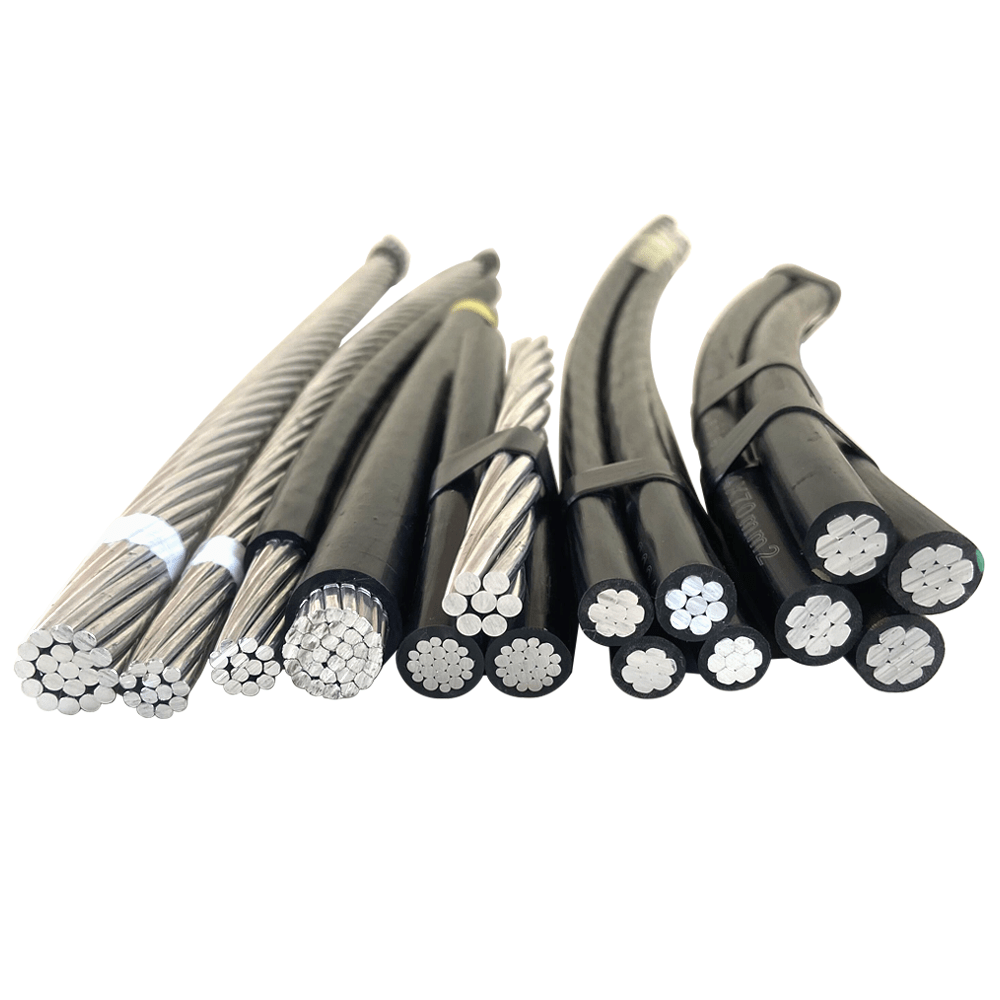
Many people believe that overhead insulated cables are simply bare wires “covered in a plastic shell.” This is not the case! They are high-performance power products specifically designed for long-term outdoor operation. TST CABLE overhead insulated cables have four core advantages:
✅ Fully Insulated Structure: Using weather-resistant cross-linked polyethylene (XLPE) or polyvinyl chloride (PVC) as the insulation layer, they can withstand ultraviolet radiation, ozone, and aging at high and low temperatures (-40℃~+70℃), with a lifespan exceeding 25 years.
✅ Anti-electric shock design: Even if a person touches the insulation surface directly, the induced current is <0.1mA (far below the 50mA lethal threshold), greatly improving safety.
✅ Strong anti-interference capability: Phase-to-phase insulation prevents flashover, significantly reducing short-circuit tripping caused by lightning strikes and pollution.
✅ Flexible installation: Can be laid along walls, erected through forests, or even hung under the eaves of ancient buildings, without requiring a wide “electrical corridor”.
Key reminder: Products conforming to GB/T 12527-2008 “Overhead Insulated Cables with Rated Voltage of 1kV and Below” must be selected. Inferior insulation layers are prone to cracking, creating hidden dangers.
Real Case: Small Investment, Big Change
Shanghai Old City Renovation: “Hidden” Cables, Enhanced Safety
In a century-old Shikumen neighborhood in Huangpu District, the underground pipelines were complex, and excavation costs were extremely high. Using 1kV overhead insulated cables laid along the walls preserved the historical appearance while eliminating the risk of electric shock. After the upgrade, the line failure rate decreased by 90%, and resident satisfaction soared.
Nagqu Rural Power Grid, Tibet: Stable Power Supply Even at High Altitudes High altitude, strong ultraviolet radiation, and winter temperatures as low as -30°C make ordinary cables prone to brittleness. Locally, cold-resistant XLPE insulated cables with UV-resistant outer sheaths, along with specialized fittings, have been selected to achieve year-round trouble-free operation, finally providing herders with reliable electricity.
Moganshan Homestay Cluster, Zhejiang: A Perfect Blend of Aesthetics and Practicality To protect the ecological landscape, the scenic area prohibits the erection of new poles and the digging of ditches. The power company uses self-supporting three-core stranded overhead cables that directly cross streams and forests, making them virtually “invisible” to the eye, eliminating the need for tourists to Photoshop out power lines when taking photos.
Industry Trends: From “Usable” to “Smart + Green”
Material Upgrades: TST CABLE’s new generation of low-smoke halogen-free (LSOH) insulation material has become mainstream, releasing no toxic gases in case of fire, making it safer and more environmentally friendly.
Intelligent Integration: Some pilot projects have integrated fault indicators and temperature sensors into overhead lines, achieving “automatic fault location” and reducing repair time by 70%. Rural Revitalization Mainstay: The State Grid’s “Rural Power Grid Consolidation and Improvement Project” explicitly promotes the use of overhead insulated cables, aiming to complete insulation upgrades for over 80% of rural low-voltage lines by 2025.
Prefabricated Construction: Factory-pre-assembled hardware and insulators allow for immediate use on-site, increasing construction efficiency threefold and reducing power outage time.
Invisible Cable Upgrades, Visible Safety Guarantee: TST CABLE low-voltage overhead insulated cables may seem like just “changing a wire,” but they represent a low-cost, high-efficiency systemic upgrade for urban governance, rural revitalization, and safe electricity use. They hang silently in the air, quietly protecting the lights of countless homes—eliminating the fear of electric shock, frequent power outages, and the tangled “spider web” of cables.
In the future, with the accelerated development of new urbanization and smart distribution networks, this “aerial safety line” will continue to extend to more corners. After all, true modernization lies not only in skyscrapers but also in the reliability of every single power line.
Also available in:
 English