
Core processes such as semiconductor etching, thin film deposition, photolithography, and precision testing require equipment to be exposed to harsh environments such as ultra-high vacuum, wide temperature range alternating, fretting friction, and high-frequency electrical loads for a long time. This places extremely stringent requirements on cable cleanliness, electrical stability, mechanical durability, and temperature range adaptability. As the core carrier of equipment signal and power transmission, cable quality directly determines equipment utilization rate and wafer yield rate. Traditional wrapped PI cables are limited by the inherent defects of the laminated structure. They have natural shortcomings such as high vacuum outgassing, poor electrical stability, easy mechanical breakage, and insufficient temperature coverage. They cannot adapt to high-end semiconductor process standards and have become hidden dangers for the long-term stable operation of precision equipment.
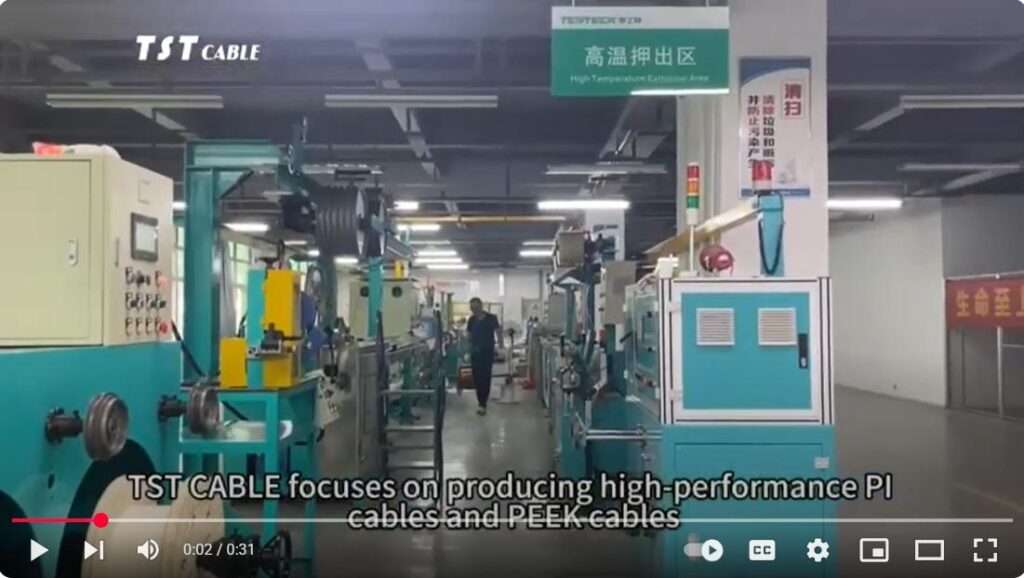
Having been deeply involved in the field of special cables for more than 20 years, TST cable has targeted the structural pain points of traditional wrapped cables and launched integrated seamless extruded PI cables. Relying on the new process innovation to avoid traditional product defects from the root, it is fully adapted to high-end scenarios such as semiconductor UHV cavity, ultra-low temperature testing, high-frequency precision signal transmission, etc. It is a highly reliable selection solution for the localization of semiconductor equipment.
1. Innovate the extrusion process and fully adapt to extreme working conditions
TST cable extruded PI cable adopts a continuous one-piece extrusion molding process of molten PI raw materials. The outer layer of the conductor forms a seamless, dense and homogeneous overall insulation layer, which eliminates defects in the wrapping process from the structure. All performances have passed third-party authoritative testing.
Ultra-low air output, suitable for ultra-high vacuum chambers
The product does not contain plasticizers, additives and ordinary toners. All products have passed ASTM E595 standard testing: TML <1%, CVCM <0.1% for conventional UHV cables, TML <0.8%, CVCM <0.10% for ultra-low temperature ultra-vacuum cables. No harmful substances will be precipitated when baked at 250°C. The product can operate in an ultra-high vacuum environment of 10⁻⁷~10⁻¹²mbar for a long time and meets the wiring standards of photolithography machines, etching machines, and thin film deposition equipment.
Excellent electrical performance, ensuring high-frequency signal transmission
The insulation resistance is ≥1×10¹⁶Ω·cm, the insulation layer has no pinholes, and it has excellent voltage resistance and electromagnetic interference resistance. The seamless structure effectively eliminates electric field distortion, and the partial discharge performance is significantly better than traditional wrapped cables, eliminating hidden dangers of discharge under high-frequency pulse conditions. The product’s rated voltage covers 300V/600V/1000V, taking into account equipment low-voltage control and medium-voltage power transmission.
Ultra-wide temperature range, resistant to hot and cold cycles
The long-term working temperature of conventional extruded PI cables is -269°C (liquid helium) to 260°C, and the short-term temperature resistance can reach 300°C; the special ultra-low temperature and ultra-vacuum cable has a maximum temperature resistance of 400°C, and can be adapted to both cryogenic testing and high-temperature chamber conditions. The cable can withstand repeated thermal shocks in the temperature range from room temperature to liquid helium, and the insulation layer will not crack or fall off. It is suitable for various low-temperature processes and temperature cycle tests.
Outstanding mechanical strength and easy wiring in small spaces
The product is resistant to scratches and abrasions ≥ 20,000 times, and can cope with internal threading, continuous vibration and other working conditions of the equipment for a long time. Compared with traditional wrapped cables, the outer diameter is reduced by 5% to 10% and the overall weight is reduced by 15%, effectively saving the internal space of the equipment. The insulation layer is combined with the conductor at the molecular level and will not crack when stretched by 25%. The entire series is matched with exclusive bending radii according to specifications to meet the needs of compact space wiring.
Radiation resistance and strong chemical stability
It can withstand 10⁹Rad radiation dose and is suitable for strong radiation scenarios such as radiation detection and particle accelerators. The cable has excellent chemical inertness, is resistant to acids, alkalis and organic solvents, does not react with semiconductor process gases, and has stable performance without degradation over a long period of time.
2. Precise selection guide for different scenarios
1. Ultra-high vacuum cavity wiring (etching/deposition/photolithography)
Recommended model: TST-UHV-S/J/D series
Applicable conditions: 10⁻⁹~10⁻¹²mbar vacuum environment, can withstand 200℃ baking
Selection suggestions: Use single conductor TST-UHV-S for fixed wiring, and the unshielded design further reduces the amount of outgassing; use multi-stranded TST-UHV-J for dynamic flexible wiring; choose TST-UHV-D with low outgassing shielding sheath for multi-core control loops. The entire series complies with ASTM E595 testing standards.
2. Extremely low temperature testing and superconducting equipment (4K~77K)
4K liquid helium + high-voltage working condition: choose TST-GYPIT liquid helium environment 4K polyimide high-voltage cable, suitable for DC15/20/30kV voltage;
77K liquid nitrogen signal transmission: TST-SDJPI-DYT liquid nitrogen 77K polyimide cable is selected, and the low noise characteristics match the low temperature sensor;
Ultra-low temperature + ultra-high vacuum composite working conditions: Use TH/J-PIPIP-DYT ultra-low temperature and ultra-vacuum polyimide cables. It is recommended to use silver-plated conductors with a silver layer thickness of ≥5 μm to enhance low-temperature conductive stability.
3. High-frequency signals and precision detection (probe station/measuring equipment)
Recommended model: TST-CP/P ultra-high vacuum coaxial cable
Applicable conditions: 50Ω standard impedance, low dielectric loss, strong anti-interference
Selection suggestions: Use silver-plated copper stranded conductors and dense insulation with PI, with a shielding coverage of >90%, which can stably transmit high-frequency and precise detection signals in a small vacuum space.
4. High temperature cavity and power connection (diffusion furnace/oxidation furnace)
Recommended models: TST-PI radiation-resistant and high-temperature resistant PI cable, TST-PEEK radiation-resistant polyetheretherketone cable
Applicable conditions: long-term high temperature, aging resistance, radiation resistance
Selection suggestions: TST-PI cable has a temperature resistance of 4K~300℃, complete voltage specifications, and is suitable for mainstream high-temperature power and signal lines; TST-PEEK cable has a temperature resistance of -65℃~250℃, outstanding insulation performance, and is suitable for high vacuum + high temperature composite working conditions.
Avoid pitfalls when choosing a model: three core parameters must be verified
TIPS
Vacuum outgassing index: Verify the ASTM E595 test report, distinguish product parameters, and reject verbal “low outgassing” propaganda.
Partial discharge performance: PDIV actual measurement data needs to be checked in high-frequency and high-voltage scenarios, and discharge risks can be avoided by relying on the advantages of seamless structure.
Conductor material and coating: Silver-plated copper and oxygen-free copper conductors are used under normal working conditions; in the extremely low temperature scenario of -269°C liquid helium, silver-plated conductors with a silver layer thickness of ≥5 μm must be used to prevent oxidation and volatilization.
When selecting semiconductor equipment cables, adaptability is far more important than pure product positioning. TST cable extruded PI cable uses mature seamless extrusion technology, traceable measured performance, and stable performance in the full temperature range to specifically solve application problems such as semiconductor ultra-high vacuum, ultra-low temperature, and high-frequency transmission.
Whether it is imported equipment replacement, new machine matching, or special process customization, we can provide standard cables and personalized overall solutions to protect the efficient operation of semiconductor equipment with reliable products and stabilize the bottom line of wafer yield.
Also available in:
 English