
Precision high-temperature interconnect solutions for high-end equipment
2.5mm outer diameter PEEK (polyetheretherketone) cable is a highly integrated and reliable specialty cable widely used in high-end applications with stringent requirements for space constraints, high temperature resistance, radiation resistance, and signal integrity. Its typical structure consists of: multi-core signal/power conductors + ultra-thin PEEK insulation (0.2–0.4mm/layer) + braided shielding + PEEK outer sheath. While maintaining a small outer diameter, it achieves excellent performance such as long-term temperature resistance up to 250℃, UL94 V-0 flame retardancy, and low dielectric loss.
I. Typical Structure and Key Technical Parameters of 2.5mm PEEK Cable
1.1 Common 2.5mm PEEK Cable Structure
Core performance indicators
| parameter | index | Test Standards |
| outer diameter | 2.5 ± 0.1 mm | IEC 60811-201 |
| Rated voltage | 600 V AC / 850 V DC | UL 758 |
| Continuous operating temperature | -65℃ ~ +250℃ | UL 746B (RTI 250℃) |
| Flame retardancy | UL94 V-0 (0.4mm) | UL 94 |
| Dielectric strength | ≥25 kV/mm | IEC 60243 |
| Bending radius | ≥5×D (i.e. ≥12.5mm) | ASTM D2135 |
| Radiation resistance | ≥100 kGy (γ) | IEC 60544 |
II. Core Application Scenarios and Value Validation of TST CABLE 2.5mm PEEK Cable
2.1 Aerospace (Space and Airborne Systems)
| Application areas | Function | Value of PEEK 2.5mm cable |
| Satellite attitude control system | Reaction wheel motor control line | Small outer diameter suitable for confined cabins, resistant to 10⁵ Gy radiation |
| Aircraft engine sensors | Temperature/Vibration/Pressure Monitoring | 250℃ temperature resistant, a replacement for bulky metal armored lines |
| Drone flight control | IMU/Servo Signal Line | Lightweight (20% lighter than PTFE), resistant to high-frequency vibration |
Application scenario :
“The antenna brackets and cable outer layers of the Beidou three-star satellites cannot do without it” – the 2.5mm specification is often used for satellite sensor wiring.
2.2 High-end robots (humanoid/surgical/industrial)
| Scene | need | Advantages of the PEEK solution |
| Humanoid robot joints | Motor power + encoder signal | 2.5mm outer diameter, compatible with Φ8–10mm cable trays, withstands 200℃+ million bends. |
| Surgical robotic arm | Visual/force feedback signal line | Medical-grade PEEK, capable of repeated steam sterilization (134℃ × 1000 times). |
| Collaborative robot wrist | Multi-axis servo control line | High flexibility (bending radius 12.5mm), no cold flow deformation. |
Case Study :
“The total amount of PEEK material required for the joints, gears, bushings, seals, and other parts of a humanoid robot is approximately 10–12 kg”—of which 2.5 mm cables account for more than 30%.
2.3 New Energy and Power Electronics
| equipment | application | value |
| 800V electric vehicle electric drive | Inverter to motor three-phase line | Resistant to corona discharge up to +250℃, supports SiC high-frequency switching |
| Hydrogen electrolyzer | Electrode monitoring signal line | Resistant to KOH corrosion and high humidity, with stable insulation. |
| Photovoltaic junction box | High-temperature zone connection wire | UV resistant +250℃, lifespan >25 years |
Case Study: A new energy vehicle’s 800V platform uses 2.5mm PEEK three-core cables, reducing the weight of the wiring harness by 15% and passing the needle penetration test without catching fire.
2.4 Semiconductors and Medical Devices
| field | application | PEEK Advantages |
| Etching machine | RF matching network | Ultra-high purity (metal ions ≤ 1 ppb), prevents wafer contamination. |
| MRI equipment | Gradient coil signal line | Non-magnetic and low dielectric loss ensure imaging accuracy. |
| Proton therapy | Beam scanning magnet line | Withstands 10⁴ Gy/year of X-rays, dimensionally stable |
3. Why choose 2.5mm instead of other specifications?
| outer diameter | Applicable Scenarios | Limitations |
| <2.0mm | Miniature sensors (such as endoscopes) | Current carrying capacity <1A, insufficient mechanical strength |
| 2.5mm | Optimal balance: • Current carrying capacity 3–5A • 4–6 core integration • Bending radius <15mm | Mainstream choice for high-end equipment |
| >3.0mm | Main power bus | Difficult to wire in joints/confined spaces |
✅ 2.5mm is the golden size for “high functional density + high mechanical robustness”.
IV. Progress in Localization and Supply Chain
4.1 Representative Domestic Products
| enterprise | Product Model | Certification |
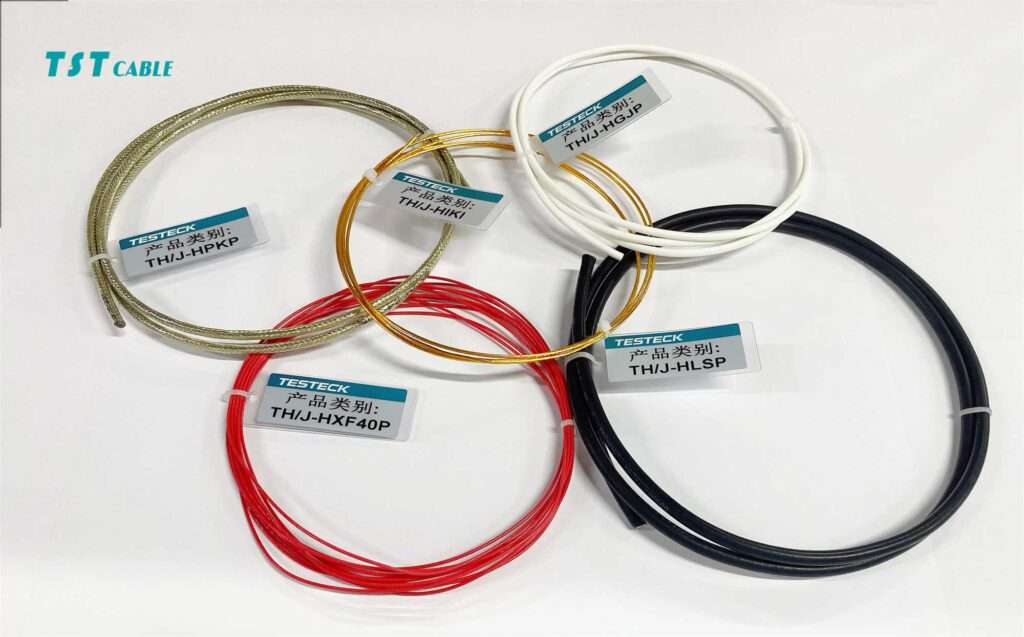
| TST CABLE | TH/J-HPKP | GJB, CASC aerospace certification , UL, etc. |
4.2 Cost and Delivery
Imported brands (TE/Tyco): $8–12/month
Domestic brands: ¥40–60/m (≈$5.5–8/m)
Delivery time: 1-4 weeks for domestic products , 8-12 weeks for imported products.
Trend: Domestically produced 2.5mm PEEK cables have been used in C919 wiring harnesses, Optimus second-generation prototypes, and GW constellation satellites.
V. Selection and Implementation Recommendations
5.1 Key Selection Parameters
>180℃
Outer diameter ≤ 2.5mm
High frequency/high voltage
Aviation/Medical
Operating temperature
Must PEEK
Space constraints
2.5mm specification is preferred
signal type
Confirm Dk/tanδ/CTI
Certification Requirements
Check UL/ISO10993
5.2 Installation Precautions
Minimum bending radius: ≥12.5mm (to avoid microcracks)
Fixed spacing: ≤100mm (to prevent vibration fatigue)
Termination process: Laser welding is recommended (crimping pliers should not be used as they can damage PEEK).
Compatible connectors: MIL-DTL-38999 III, LEMO B series
VI. Future Evolution of TST CABLE 2.5mm PEEK Cable
Smaller diameter: 2.0mm PEEK cable (for dexterous hands/microrobots)
Intelligent integration: Built-in FBG fiber optic cable → Real-time monitoring of strain/temperature
Multifunctional composite: power supply + signal + fiber optic cable in one unit (outer diameter still ≤2.5mm)
Bio-based PEEK: Reduce carbon footprint and meet ESG requirements
Small size, big impact
“Within a small space, it bears a weighty responsibility.”
Though thin, 2.5mm PEEK cables are the invisible pillars supporting the reliable operation of high-end equipment:
traversing radiation belts in satellites,
bending millions of times in robot joints,
resisting corona corrosion in 800V electric drives,
and safeguarding life signals in operating rooms.
With the mass production of humanoid robots, the deployment of low-Earth orbit constellations, and the rise of electric aviation,
2.5mm PEEK cables are moving from being a “special option” to becoming a “standard configuration”.
TST CABLE recommends:
Space-constrained and high-temperature scenarios: Prioritize the evaluation of 2.5mm PEEK cables.
Domestic substitution: Prioritize TST CABLE certified products or customized products .
Design Collaboration: Early involvement in cable selection to optimize cabling space
The true beauty of engineering lies in achieving maximum reliability with minimal volume .
Also available in:
 English