
Rack power has climbed from 8 kW to 60 kW, trays are fuller every year, and the question has shifted from “is it rated?” to “what happens when it burns, and can it shed heat?” What data centers lack is not cable but a selection sheet that settles smoke, derating and redundancy at once.
1. Duty Profile: Three Constraints
1.1 Smoke and acid kill first
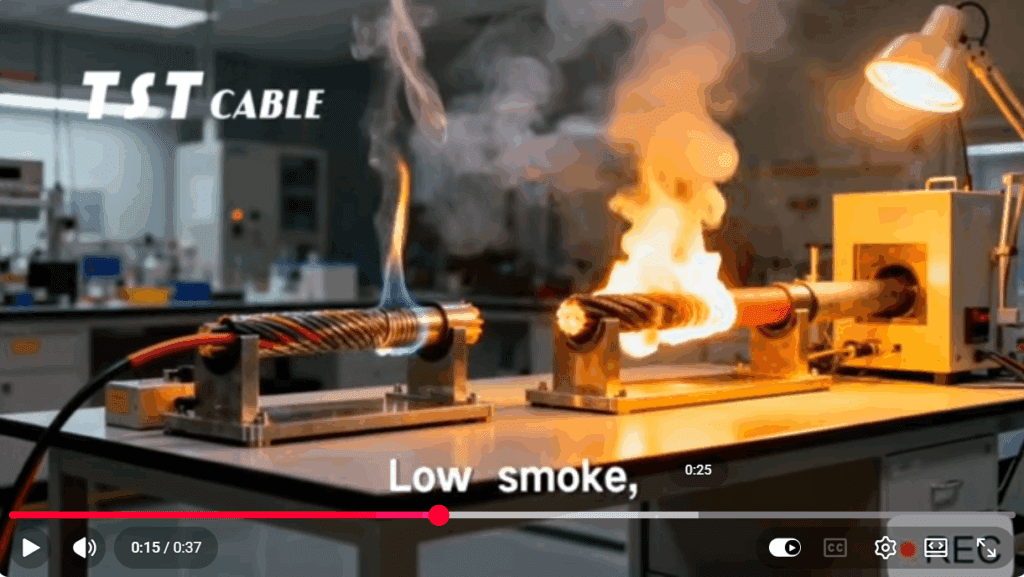
Above 200 °C, PVC jackets release hydrogen chloride; combined with water it becomes hydrochloric acid that corrodes boards and drives. Dense smoke also hides the fire from sprinklers. Server rooms and egress routes therefore specify LSZH, judged by IEC 61034 light transmittance and IEC 60754-1 acid gas content — not by the word “flame retardant”.
1.2 Once bundled, both flame class and ampacity change
Passing IEC 60332-1 alone does not make a bundle safe. Non-metallic volume per metre sets the class (IEC 60332-3-24 Category C). Ampacity must also be derated: 0.8 for 6–9 parallel runs, 0.7 above 20, one step lower again beyond 40% tray fill. Field case: a cloud site designed on single-cable ampacity saw joint temperatures 18 K over limit after three months at full load.
2. Product and Parameters
Parameter | Typical value | Notes |
Jacket | LSZH polyolefin | Low smoke and acid gas; weaker mechanically than PVC |
Oxygen index | ≥32 (PVC 23–30) | Higher means harder to sustain combustion |
Smoke density | IEC 61034 ≥60% transmittance | Drives evacuation and firefighting |
Acid gas | IEC 60754-1 HCl <0.5% | Corrosion is the main cause of equipment write-off |
Bundle rating | IEC 60332-3-24 Category C | Based on non-metallic volume, not conductor size |
Derating | 0.8 at 6–9 runs; 0.7 above 20 | One step lower beyond 40% fill |
Bend radius | 8× OD fixed, 4× unshielded | LSZH is stiff and scrapes easily |
3. Applications
3.1 Server room copper and fibre
Crosstalk margin, not bandwidth, is the trap: 30 bundled Cat6A U/UTP cables leave about 2 dB of headroom. F/FTP foil plus braid restores 8 dB at the cost of 1.2 mm OD and an 8× bend radius. Use OM4/OM5 fibre with LSZH sheath and cable management rings — never cinch ties.
3.2 Plenum and return-air paths
Return air carries combustion products straight back into the hall, so plenum runs require NFPA 262 CMP cable. At two to three times the price of LSZH, many projects switch back and get rejected by the fire consultant. Buy in segments: CMP in the plenum, LSZH inside the hall, roughly 30% saved.
3.3 RPPs and fire-linked circuits
Keep A/B paths physically separate, at least 300 mm apart. Fire pumps, smoke exhaust fans and emergency lighting need circuit integrity: mica-tape cable to IEC 60331-1 (950 °C/90 min). Do not terminate it like ordinary wire — mica tape hates knife stripping; leave 30 mm of strip length.
4. Trade-offs and Alternatives
LSZH wins on smoke and acid gas, loses on mechanical strength and oil resistance, and costs 20–30% more. Use PUR in oily or outdoor segments; for cost-sensitive detached auxiliary areas, flame-retardant PVC in metal trunking is an acceptable compromise.
5. Installation and Failure Modes
Three recurring problems: uncalculated bundle derating, overtightened ties crushing the jacket and spiking return loss, and power and data sharing a tray without a divider so VFD noise causes errors. Sample 10% of links for return loss and crosstalk at acceptance — far cheaper than troubleshooting later.
6. FAQ
Q1 Is LSZH mandatory in a data center?
For the server hall and egress routes, yes in practice. Detached auxiliary areas may relax it, subject to fire and insurer review.
Q2 CMP versus LSZH?
CMP is an NFPA 262 plenum rating covering flame spread and smoke; LSZH covers acid gas and smoke density. They are not interchangeable.
Q3 How is the bundle class determined?
From non-metallic volume per metre against IEC 60332-3 categories A–D, independent of conductor size.
Q4 Should ampacity be derated?
Yes. Multiply the factors for parallel runs, ambient temperature and fill ratio; 0.6–0.75 is typical, and ignoring it is the leading cause of hot trays.
Also available in:
 English