
TST CABLE’s aerospace-grade PEEK (polyetheretherketone) cable material not only boasts high performance in extreme environments but also exhibits outstanding environmental performance, far surpassing traditional engineering plastics and halogen-containing flame-retardant materials. It not only meets the world’s most stringent environmental regulations but also embodies green sustainability throughout its entire lifecycle (from production to disposal).
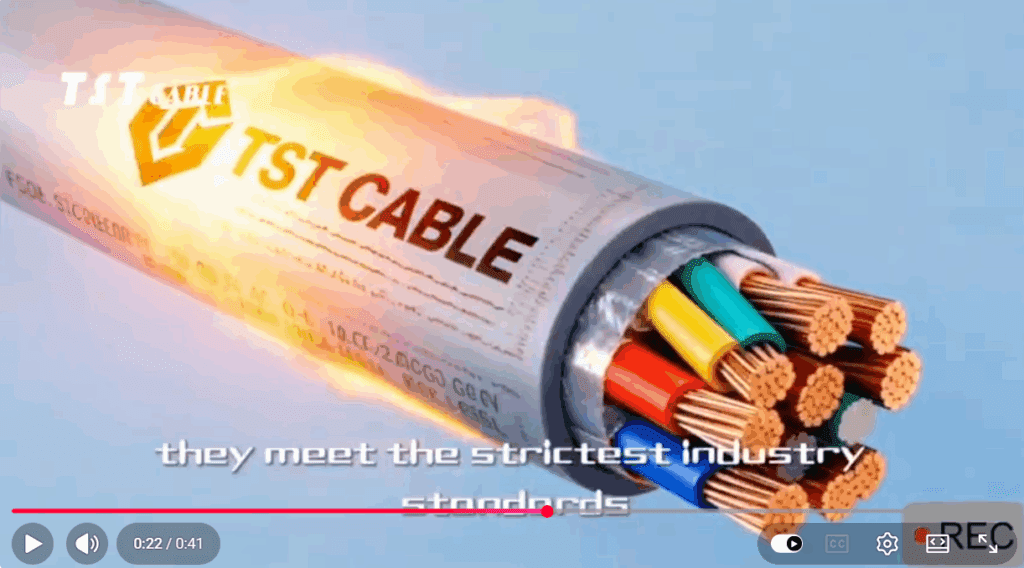
1. Low smoke and halogen-free : Eliminating toxic substances at the source
✅ Core Advantages:
Halogen-free (Cl, Br), phosphorus-free, and heavy metal-free
It does not produce the following during combustion:
Corrosive gases such as hydrogen chloride (HCl) and hydrogen bromide (HBr)
Persistent organic pollutants (POPs) such as dioxins and furans.
Acidic fumes (pH > 6.0, conforming to IEC 60754-2)
Actual measurement data (based on IEC 60754-2):
HCl release: < 0.1 mg/g (Standard limit: ≤5 mg/g)
Total amount of corrosive gases: < 0.5 mg/g
Significance: In the event of a fire in a confined space (such as a satellite cabin, an airplane cabin, or a subway car), it ensures the safety of personnel during escape and protects equipment from secondary corrosion.
II. Low smoke and low toxicity: Meets the highest international safety standards
| Test Project | TST CABLE Aerospace-grade PEEK Cable Performance | Relevant standards | Require |
| Smoke density (Dsₘₐₓ) | < 50 | ASTM E662 / FAR 25.853 | < 200 (Airline) |
| Toxicity Index (CIT) | < 1.0 | NES 713 (British Navy) | < 5.0 |
| Oxygen Index (LOI) | > 35% | ISO 4589-2 | > 28% (self-extinguishing) |
✈️ Application value:
Meets the mandatory requirements of FAA FAR 25.853 (civil aviation), EN 45545-2 HL3 (rail transit), GJB 726A (military) for low smoke and non-toxicity.
III. Low exhaust rate: Protecting the space environment and precision payloads.
In a vacuum environment, material volatiles can condense on the surfaces of optical lenses, solar cells, and sensors, leading to performance degradation or even failure. Aerospace-grade PEEK offers extreme control over this:
NASA ASTM E595 test results:
Total mass loss (TML): < 0.5% (Standard limit: ≤1.0%)
Condensable volatile matter (CVCM): < 0.1% (Standard limit: ≤0.1%)
Significance:
It is one of the few polymers that can simultaneously meet the requirements of TML<0.5% + CVCM<0.1%, and is widely used in high-value missions such as the Hubble Telescope, Beidou satellite, and Mars rover.
IV. Recyclability and Life Cycle Environmental Friendliness
4.1 Recyclable Design
PEEK is a thermoplastic that can be reused through melt re-granulation (recycling rate >90%).
Unlike thermosetting materials (such as epoxy resin), it does not require chemical degradation.
4.2 Advantages of Carbon Footprint
Lightweight: With a density of only 1.32 g/cm³, it can reduce weight by 60–70% by replacing metals, significantly reducing launch energy consumption and carbon emissions of aircraft.
Example: Reducing the weight of a single satellite by 10kg → reducing CO₂ launches by approximately 5 tons.
Long lifespan: Designed for a lifespan of 15–20 years, reducing replacement frequency and resource consumption.
4.3 Environmental protection in the production process
The synthesis process employs closed-loop solvent recovery (diphenyl sulfone recovery rate >99%).
Leading domestic companies (such as Zhongyan Technology) have achieved near-zero wastewater discharge and RTO incineration of waste gas.
V. TST CABLE PEek cable compliance: Fully compliant with global environmental regulations.
| Regulations/Standards | Eligible conditions |
| RoHS (EU) | ✅ Free of lead, cadmium, mercury, hexavalent chromium, PBB, and PBDE |
| REACH (European Union) | ✅ Not listed in the SVHC candidate list |
| Halogen-free requirement (IEC 61249-2-21) | ✅ Br < 900ppm, Cl < 900ppm (actual measurement < 100ppm) |
| China’s “Regulations on the Restriction of Hazardous Substances in Electrical and Electronic Products” | ✅ Meets the standard |
| NASA outgassing database | ✅ Included in the list of qualified materials |
VI. Environmental friendliness comparison with traditional aerospace materials
| Material | halogen | Smoke density | TML (%) | Recyclability | Environmental rating |
| Aerospace-grade PEEK | none | <50 | <0.5 | ✅ Thermoplastic | ⭐⭐⭐⭐⭐ |
| PTFE (Teflon) | none | <30 | <0.1 | ❌ Difficult to degrade | ⭐⭐⭐☆ |
| silicone | none | 100–200 | 1.0–2.0 | ❌ Thermosetting | ⭐⭐☆ |
| Halogenated flame retardant XLPO | have | >300 | 0.5–1.0 | ❌ | ⭐ |
PEEK is the only aerospace engineering plastic that combines high performance, intrinsic halogen-free properties, low emission, and recyclability.
Green aerospace starts with materials.
Aerospace-grade PEEK not only enables spacecraft to “fly higher and more stably,” but also allows humanity’s exploration of the universe to “go greener.”
Its pure molecular structure safeguards the cleanliness of space;
its silent combustion ensures the passage of life;
and its lightweight body reduces the burden on Earth.
“Truly high-end materials must not only conquer extreme environments, but also respect the Earth and life.”
In an era of carbon neutrality and sustainable development, aerospace-grade PEEK is becoming a benchmark material for green and high-end manufacturing.
How environmentally friendly are TST CABLE ‘s aerospace-grade PEEK cables ?
TST CABLE’s aerospace-grade PEEK (polyetheretherketone) cable material not only boasts high performance in extreme environments but also exhibits outstanding environmental performance, far surpassing traditional engineering plastics and halogen-containing flame-retardant materials. It not only meets the world’s most stringent environmental regulations but also embodies green sustainability throughout its entire lifecycle (from production to disposal).
1. Low smoke and halogen-free : Eliminating toxic substances at the source
✅ Core Advantages:
Halogen-free (Cl, Br), phosphorus-free, and heavy metal-free
It does not produce the following during combustion:
Corrosive gases such as hydrogen chloride (HCl) and hydrogen bromide (HBr)
Persistent organic pollutants (POPs) such as dioxins and furans.
Acidic fumes (pH > 6.0, conforming to IEC 60754-2)
Actual measurement data (based on IEC 60754-2):
HCl release: < 0.1 mg/g (Standard limit: ≤5 mg/g)
Total amount of corrosive gases: < 0.5 mg/g
Significance: In the event of a fire in a confined space (such as a satellite cabin, an airplane cabin, or a subway car), it ensures the safety of personnel during escape and protects equipment from secondary corrosion.
II. Low smoke and low toxicity: Meets the highest international safety standards
| Test Project | TST CABLE Aerospace-grade PEEK Cable Performance | Relevant standards | Require |
| Smoke density (Dsₘₐₓ) | < 50 | ASTM E662 / FAR 25.853 | < 200 (Airline) |
| Toxicity Index (CIT) | < 1.0 | NES 713 (British Navy) | < 5.0 |
| Oxygen Index (LOI) | > 35% | ISO 4589-2 | > 28% (self-extinguishing) |
✈️ Application value:
Meets the mandatory requirements of FAA FAR 25.853 (civil aviation), EN 45545-2 HL3 (rail transit), GJB 726A (military) for low smoke and non-toxicity.
III. Low exhaust rate: Protecting the space environment and precision payloads.
In a vacuum environment, material volatiles can condense on the surfaces of optical lenses, solar cells, and sensors, leading to performance degradation or even failure. Aerospace-grade PEEK offers extreme control over this:
NASA ASTM E595 test results:
Total mass loss (TML): < 0.5% (Standard limit: ≤1.0%)
Condensable volatile matter (CVCM): < 0.1% (Standard limit: ≤0.1%)
Significance:
It is one of the few polymers that can simultaneously meet the requirements of TML<0.5% + CVCM<0.1%, and is widely used in high-value missions such as the Hubble Telescope, Beidou satellite, and Mars rover.
IV. Recyclability and Life Cycle Environmental Friendliness
4.1 Recyclable Design
PEEK is a thermoplastic that can be reused through melt re-granulation (recycling rate >90%).
Unlike thermosetting materials (such as epoxy resin), it does not require chemical degradation.
4.2 Advantages of Carbon Footprint
Lightweight: With a density of only 1.32 g/cm³, it can reduce weight by 60–70% by replacing metals, significantly reducing launch energy consumption and carbon emissions of aircraft.
Example: Reducing the weight of a single satellite by 10kg → reducing CO₂ launches by approximately 5 tons.
Long lifespan: Designed for a lifespan of 15–20 years, reducing replacement frequency and resource consumption.
4.3 Environmental protection in the production process
The synthesis process employs closed-loop solvent recovery (diphenyl sulfone recovery rate >99%).
Leading domestic companies (such as Zhongyan Technology) have achieved near-zero wastewater discharge and RTO incineration of waste gas.
V. TST CABLE PEek cable compliance: Fully compliant with global environmental regulations.
| Regulations/Standards | Eligible conditions |
| RoHS (EU) | ✅ Free of lead, cadmium, mercury, hexavalent chromium, PBB, and PBDE |
| REACH (European Union) | ✅ Not listed in the SVHC candidate list |
| Halogen-free requirement (IEC 61249-2-21) | ✅ Br < 900ppm, Cl < 900ppm (actual measurement < 100ppm) |
| China’s “Regulations on the Restriction of Hazardous Substances in Electrical and Electronic Products” | ✅ Meets the standard |
| NASA outgassing database | ✅ Included in the list of qualified materials |
VI. Environmental friendliness comparison with traditional aerospace materials
| Material | halogen | Smoke density | TML (%) | Recyclability | Environmental rating |
| Aerospace-grade PEEK | none | <50 | <0.5 | ✅ Thermoplastic | ⭐⭐⭐⭐⭐ |
| PTFE (Teflon) | none | <30 | <0.1 | ❌ Difficult to degrade | ⭐⭐⭐☆ |
| silicone | none | 100–200 | 1.0–2.0 | ❌ Thermosetting | ⭐⭐☆ |
| Halogenated flame retardant XLPO | have | >300 | 0.5–1.0 | ❌ | ⭐ |
PEEK is the only aerospace engineering plastic that combines high performance, intrinsic halogen-free properties, low emission, and recyclability.
Green aerospace starts with materials.
Aerospace-grade PEEK not only enables spacecraft to “fly higher and more stably,” but also allows humanity’s exploration of the universe to “go greener.”
Its pure molecular structure safeguards the cleanliness of space;
its silent combustion ensures the passage of life;
and its lightweight body reduces the burden on Earth.
“Truly high-end materials must not only conquer extreme environments, but also respect the Earth and life.”
In an era of carbon neutrality and sustainable development, aerospace-grade PEEK is becoming a benchmark material for green and high-end manufacturing.
Also available in:
 English