
The most confused responsibility line in LSZH compound certification: what the compound supplier certifies and what the cable maker certifies are never the same thing. A compound datasheet gives density, oxygen index, tensile strength, cone calorimetry. Euroclass, bundle burn and smoke density are all tests on a finished cable. Asking a compounder for a B2ca certificate is asking for something that cannot exist.
A delivery is split across three parties — compound supplier, cable maker, third-party laboratory — and each is listed with the documents it can and cannot issue. No brand recommendations, only where responsibility sits in the certificate chain.
How the classes are cut
Halogen-free flame retardancy works by endothermic decomposition, not by radical scavenging. Aluminium hydroxide releases water around 200 ℃, absorbing roughly 1.0 kJ/g, diluting the fuel gas and leaving an oxide layer on the surface. To matter, the loading has to reach 55–65 phr — which is also why the mechanical and processing properties drop.
Party | Can issue | Cannot issue | Why |
Compound supplier | Density, oxygen index, tensile, cone calorimetry, RoHS | Euroclass, bundle burn, smoke density | Those are tests on a finished cable |
Cable maker | Construction data, in-house burn reports on submitted samples | Independent third-party conclusion | Self-declared reports are usually rejected in tenders |
Third-party lab | EN 50399 / 61034 / 60754 reports | Design responsibility or batch consistency | Liability is limited to the sample |
Notified body | Euroclass classification certificate | Long-term supply consistency | Certificate is bound to the tested construction |
The test method decides whether classes can be compared at all
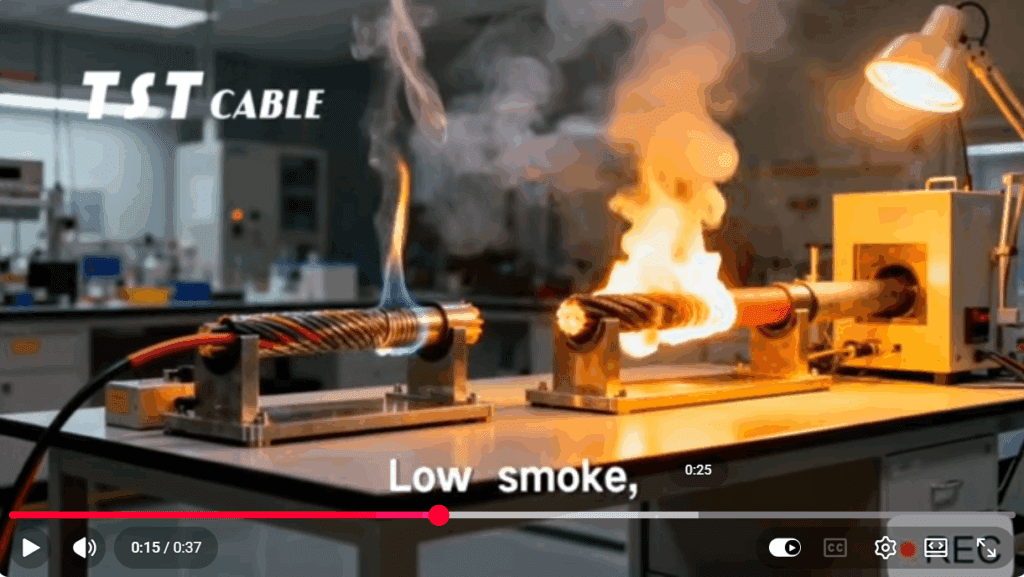
Cone calorimetry uses a 100 × 100 mm plaque at 25–50 kW/m². EN 50399 uses a 3.5 m bundle of cables with a 20.5–40 kW source. Two orders of magnitude in scale means different heat loss and a different flame path, which is why compound data screens formulations but never assigns a class.
EN 13501-6 classifies a cable product, and the specimen is the complete cable: conductor, insulation, fillers, screen and sheath. A compound is one component. Its cone calorimetry data predicts a trend but cannot be converted into a class — the missing step is a bundle test on the finished construction.
The class on the certificate is not the cable in your hand
Cold cracking has a recognisable signature: axial splits with clean edges and no necking, which means brittle fracture rather than overload. It shows up on northern winter installations when a sheath below −20 ℃ is bent or stepped on. The crack does not close on warming, water enters, and the copper greens within a year.
An LSZH sheath usually carries a 90 ℃ continuous rating and 250 ℃ for 5 s under short circuit; crosslinked versions reach 105 or 125 ℃, though 60 % filler makes 125 ℃ difficult. The 90 ℃ refers to the sheath, not the insulation. If the insulation is XLPE the conductor can run hotter, and ampacity has to be calculated on the conductor, not on the sheath figure.
65 % and 78 % transmittance on the same cable can both be genuine. IEC 61034-2 responds to sample volume, flame position and chamber soot; a 20 % difference in sample mass moves the minimum transmittance by 8–12 points. Before comparing two suppliers, compare the sample length and number of cores in their reports.
An oxygen index of 32 versus 38 often reflects where the sample came from, not the formulation. Pressed compound pellets read higher than sheath slices taken off a finished cable, because extrusion orientation and crosslinking change burning behaviour. A tender that says “OI ≥32” must also say where the sample is taken.
Where the sample came from changes the answer. A sheath slice taken from the middle of a finished cable carries extrusion orientation and a known crosslinking gradient; a pressed pellet carries neither. Labs report 3–5 points of difference in oxygen index between the two on the same compound. If the report does not say which one was tested, the number cannot be compared with anyone else’s.
How to read a test report
- Compound supplier: safety data sheet, RoHS/REACH, oxygen index and tensile data
- Cable maker: full-cable burn reports, construction drawing, batch consistency statement
- Third-party lab: raw EN 50399 / 61034 / 60754 reports with the specimen description
- Notified body: Euroclass certificate and the construction list it is bound to
- What has to be re-tested when compound, cross-section or core count changes
Related: LSZH cable; B2ca cable class.
Frequently asked questions
Can the compound maker issue Euroclass?
No. Euroclass classifies a cable, tested as a finished bundle. The compound maker supplies oxygen index, cone calorimetry and RoHS data; the missing step in the certificate chain belongs to the cable maker.
What documents should purchasing ask for?
Four: compound datasheet with RoHS, the cable maker’s full-cable burn reports, third-party 60754/61034/60332 originals, and the Euroclass certificate with the construction list it covers. Any gap invites a tender challenge.
Does the same compound give the same result in any construction?
No. Core count, cross-section, fillers and armour all change non-metallic volume and the flame path. A 4 × 6 mm² report does not cover 4 × 16 mm², which is the most common failure found at sampling.
Why does changing compound require a new sample?
Because the classification is bound to the complete material set and construction. A different compound changes heat release, smoke and acidity, so the previous class no longer applies. A new batch of the same grade does not need retesting; a new grade does.
Also available in:
 English