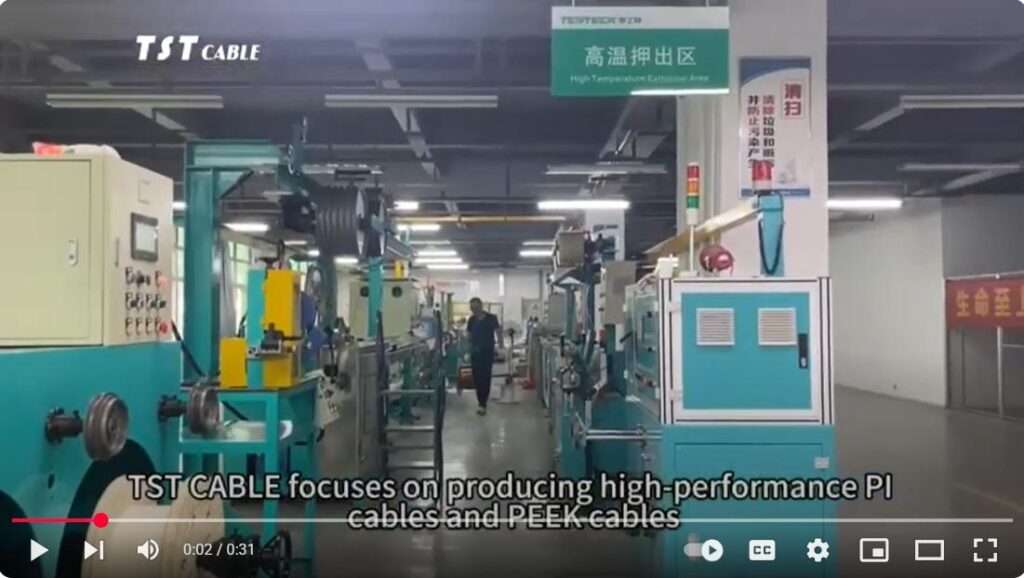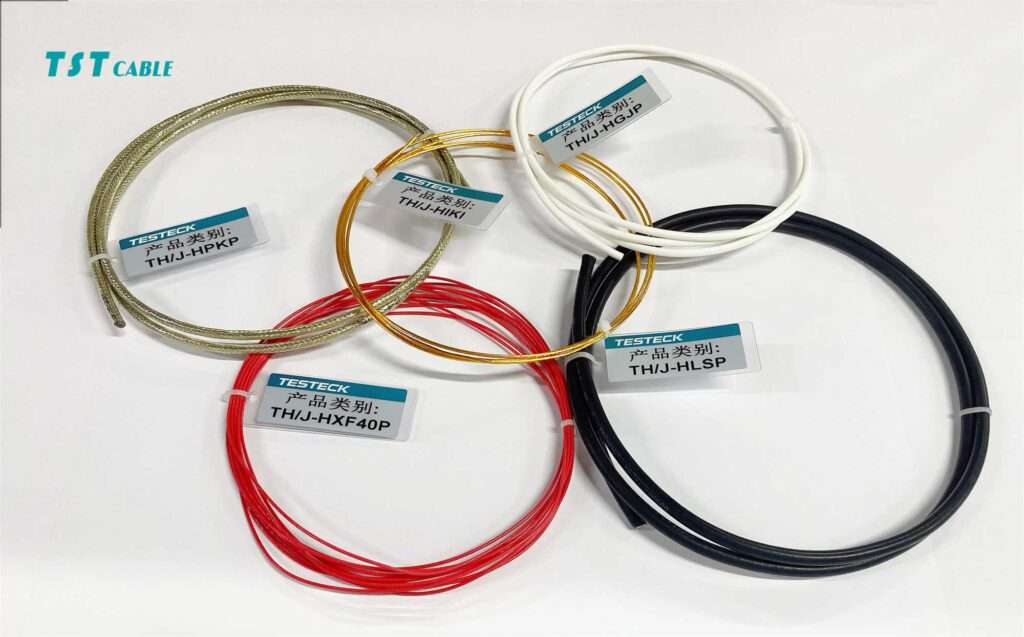

—High-reliability miniature interconnects safeguard the “nerve center” of flight.
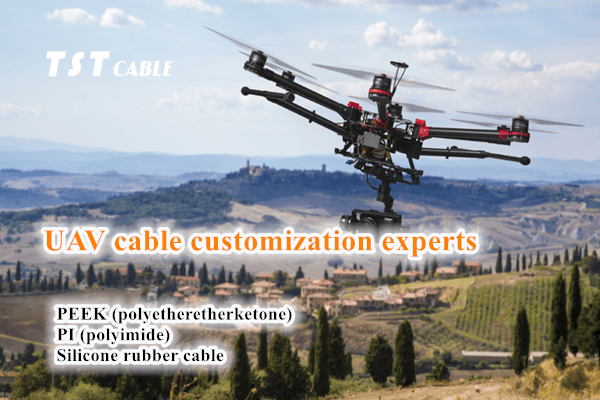
In high-performance military/industrial drones, the flight controller is the “brain” of the entire system, while the signal cables connecting the inertial measurement unit (IMU) and servos are its “nerves.” These cables need to transmit microvolt-level signals with millisecond-level precision under extreme conditions such as high-frequency vibration, wide temperature range, electromagnetic interference, and space constraints. Traditional silicone, PVC, or FEP cables are prone to signal drift, insulation aging, and mechanical breakage in this scenario. TST CABLE PEEK cable (polyetheretherketone) has become the preferred material for high-end drone flight control signal cables due to its high strength, temperature resistance, low dielectric constant, and fatigue resistance.
I. Core Challenges of UAV Flight Control Signal Lines
| Operating conditions | Require | Traditional cable defects |
| High frequency vibration | 5–2000 Hz, acceleration >10G | Silicone is prone to fatigue cracking and conductor breakage. |
| Temperature range | -40℃ ~ +125℃ (High-altitude/Desert) | PVC low-temperature embrittlement, FEP high-temperature creep |
| Signal accuracy | IMU output angle error ±0.1° | Dielectric instability → Phase noise increases |
| Space constraints | Wiring diameter in servo gear compartment <3mm | Ordinary cables have a large outer diameter, making them difficult to integrate. |
| EMI environment | Motor/Electronic Speed Controller Strong Interference | The shielding layer is easily damaged, leading to signal crosstalk. |
⚠️ Consequences: Signal distortion → Flight control misjudgment → Loss of attitude control → Crash!
II. How does TST CABLE PEEK cable solve the problem of flight control signal transmission?
2.1 Key Performance Advantages
| performance | PEEK performance | Value of flight control |
| Continuous temperature resistance | -65℃ ~ +250℃ | Covers all drone operating conditions, with no risk of thermal failure. |
| Tensile strength | 90–100 MPa | Resistant to 10G+ vibration, can withstand millions of bends without breaking. |
| Dielectric constant (Dk) | 3.2 ± 0.05 (-55~125℃) | The IMU signal has stable phase and accurate angle calculation. |
| Volume resistivity | >10¹⁶ Ω·cm | Leakage-free operation with low current (nA level) |
| density | 1.32 g/cm³ | Lightweight (15% lighter than PTFE), improving battery life |
| Outer diameter control | It can be made in the form of Φ1.0–2.5mm. | Compatible with micro servos and compact flight control modules |
✅ Knowledge base evidence:
“Even high-voltage arcs cannot penetrate it…5G Wifi signal transmission is undamaged” – verifying its high insulation + low loss characteristics;
“Even if it is inserted 1 million times, the deformation rate is only 0.3%” – directly corresponding to the scenario of repeated movement of servo motors.
III. Typical Application Structure Design (Taking TST CABLE 2.0mm PEEK Flight Control Cable as an Example)
Outer sheath: PEEK (0.2mm thickness) ← Abrasion resistant, UV resistant, low venting
Shielding layer: Silver-plated copper foil + braided (coverage ≥95%) ← Suppresses motor EMI, ensures μV-level signal insulation layer: PEEK (0.15mm per core, 4 cores stranded) ← Dk=3.2, tanδ=0.0027
Conductor: Silver-plated copper stranded wire (AWG30×7, 4 cores) ← Flexible, oxidation-resistant, low contact resistance
Overall outer diameter: 2.0 ± 0.1 mm
Bending radius: ≥10 mm (for servo joints)
Weight: ≈18 g/m (35% lighter than silicone wire)
IV. Practical Application Scenarios and Value of TST CABLE PEEK Flight Control Cable
4.1 Military Reconnaissance and Strike Unmanned Aerial Vehicles
IMU signal line: connects the flight controller and the fiber optic gyroscope, requiring angular random walk <0.01°/√h
→ PEEK low dielectric drift to ensure navigation accuracy.
Servo control lines: Vertical tail/aileron servo, daily actuation > 5,000 times
→ PEEK fatigue life > 1 million times, maintenance-free.
4.2 Industrial Inspection/Logistics Drones
High-altitude operations (>5000m): Low temperature -40℃ + strong ultraviolet radiation
→ PEEK exhibits no embrittlement and resistance to UV aging.
Frequent take-off and landing: High impact from motor start-up and shutdown
→ High-strength sheath prevents cuts
4.3 Bionic flapping-wing/micro-drone
Space constraints: Cable tray diameter < 1.5mm
→ Ultra-fine PEEK cable (Φ1.2mm) enables multi-signal integration.
V. Progress in Localization and Supply Chain Security
Material self-sufficiency: PEEK resin has passed GJB 726A aerospace material certification.
Mass production of cables: Flight control cables for a certain type of military UAV have been supplied.
Cost advantage: Domestically produced PEEK flight control cables are priced at 60-70% of imported cables, and delivery time is shortened by 50%.
TST CABLE 2.0mm PEEK flight control cable, a leading industrial drone manufacturer saw an 80% reduction in high-altitude mission failure rate and an increase in MTBF from 500h to 2000h+.
VI. Selection Recommendations
| Types of drones | Recommended specifications | Certification Requirements |
| Military/Long Endurance | 2.0–2.5mm PEEK | GJB, MIL-DTL-16878 |
| Industrial grade | 1.5–2.0mm PEEK | UL AWM, CE |
| Micro/Consumer | 1.0–1.5mm PEEK | RoHS, REACH |
Tip: Prioritize TST CABLE shielded + silver-plated conductor structure to ensure IMU signal signal-to-noise ratio >60dB.
Flying higher stems from the reliability of every thread .
Reliable flight begins with a trustworthy line.
“The flight control system is the brain of the drone, while the signal lines are its nerves.”
In the era of drones that pursue high precision, high reliability, and long lifespan,
TST CABLE PEEK cables safeguard every takeoff and return with micron-level stability.
From the snowy plateau to the tropical rainforest,
from border patrols to urban logistics,
TST CABLE PEEK flight control cables enable Chinese drones to fly more stably, farther, and with greater peace of mind.
Also available in:
 English