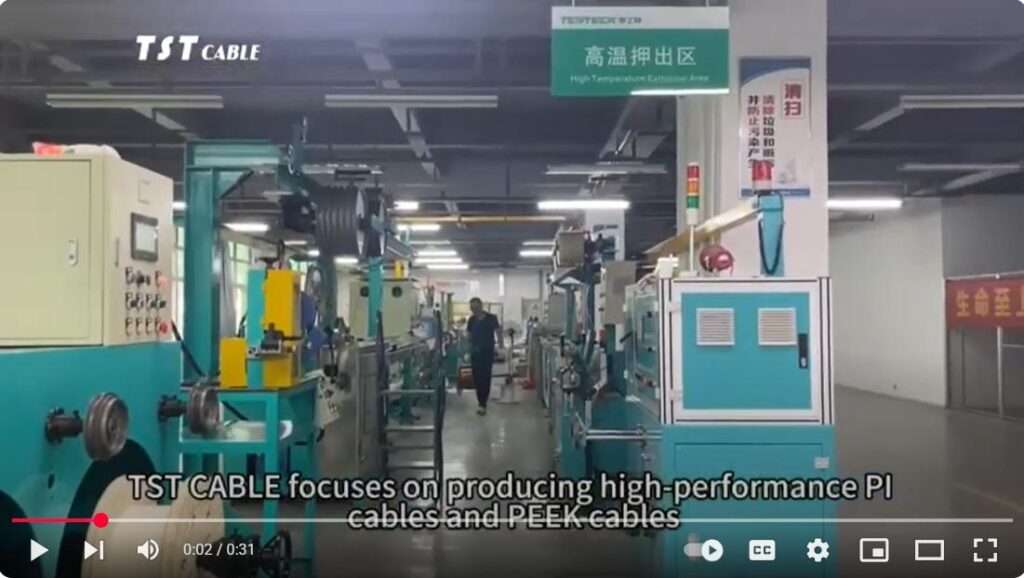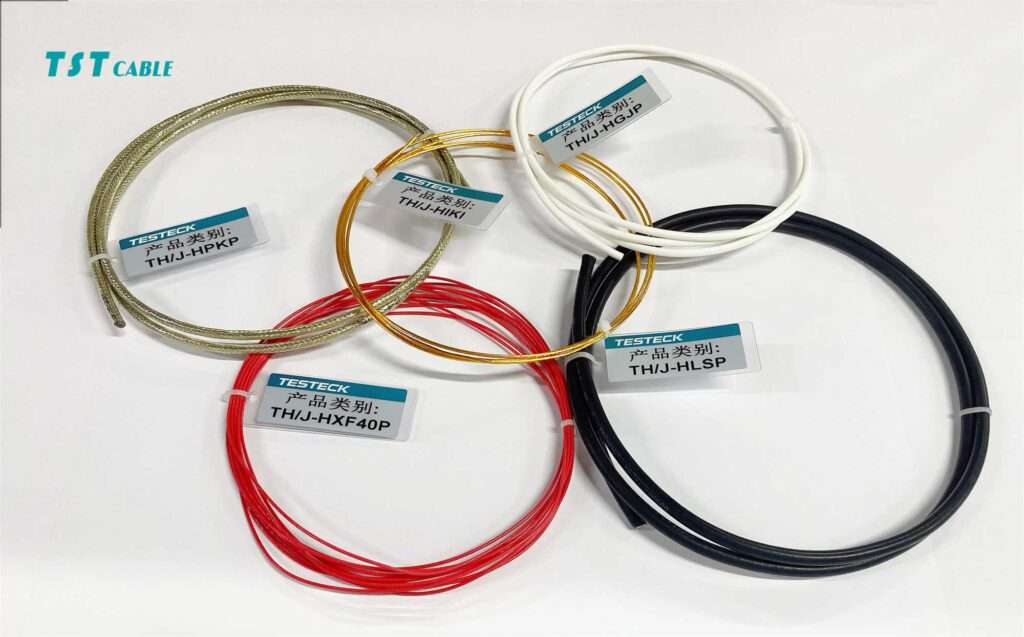

The mechanical strength of PEEK insulated wires is a key indicator for ensuring their reliability throughout their entire lifecycle, including installation, operation, and maintenance. Validation must follow a standardized testing system, employing multi-dimensional, multi-condition testing methods to comprehensively evaluate the material’s mechanical properties. Below is the standard validation process and guidelines for TST CABLE PEEEK cables. If you have any questions, please feel free to email me for discussion.
I. Core Indicators of Mechanical Strength
| index | definition | Test significance | Typical applications |
| Tensile strength | Maximum tensile stress that the material can withstand before fracture | Assess tensile strength | Vertical laying, hanging installation |
| Elongation at break | Elongation at break | Assess flexibility and impact resistance | Bending and vibration environments |
| Bending strength | The ability to resist bending deformation without breaking | Assess installation bending adaptability | Wiring in confined spaces |
| abrasion resistance | resistance to surface wear | Assessment of lifespan in frictional environments | Drag chains, mobile devices |
| Tear resistance | Ability to resist crack propagation | Assessment of damage tolerance | Risk of contact with sharp objects |
| Dynamic fatigue life | Number of failures after repeated bending/stretching | Assessment of the suitability of moving parts | Robots, elevators |
| compressive strength | The ability to resist external pressure | Assess reliability in extrusion environments | Cable trenches and conduits |
| Adhesion | Bond strength between insulation layer and conductor | Assess stratified risks | Temperature cycling, vibration |
II. Testing Standard System
| Standards Organization | Key Standards | Test content |
| ISO | ISO 527-1/-3 | Plastic tensile property testing |
| ISO | ISO 178 | Plastic flexural properties testing |
| ASTM | ASTM D638 | Standard test for tensile properties of plastics |
| ASTM | ASTM D790 | Standard test for plastic bending performance |
| ASTM | ASTM D1044 | Abrasion resistance test of transparent plastic |
| ASTM | ASTM D3032 | Mechanical property testing of winding wire |
| IEC | IEC 60851-5 | Mechanical property test of winding wire |
| IEC | IEC 60228 | Cable conductor requirements |
| GB/T | GB/T 1040 | Plastic tensile property testing |
| GB/T | GB/T 9341 | Plastic bending performance test |
| UL | UL 1581 | Wire mechanical performance testing |
| DIN VDE | DIN VDE 0285-525 | Drag chain cable dynamic testing |
✅ Recommended combination: ASTM D638 (tensile) + ASTM D790 (bending) + DIN VDE 0285-525 (dynamic fatigue)
III. Key Test Items and Methods
1. Tensile strength test
| Test parameters | Method Description | Qualification Standard |
| Sample preparation | Prepare dumbbell-shaped specimens according to ISO 527-3 | Thickness 0.5–2mm |
| stretching speed | 5–50 mm/min (select according to standard) | Conforms to ASTM D638 |
| Test temperature | Room temperature (23℃) or high temperature (250℃) | By application scenario |
| Test metrics | Maximum tensile force, elongation at break | Record stress-strain curves |
| Typical PEEK value | Tensile strength 90–100 MPa | Elongation at break: 30–50% |
| Pass line | ≥85 MPa (room temperature) | ≥25% (room temperature) |
High-temperature tensile testing: Tensile strength retention rate of ≥60% at 250℃ is considered excellent.
2. Bending strength test
| Test parameters | Method Description | Qualification Standard |
| Test methods | Three-point bending method (ASTM D790) | Span/Thickness = 16:1 |
| Bending speed | 1–2 mm/min | Meets standards |
| Test metrics | Flexural strength, flexural modulus | Record load-displacement curves |
| Typical PEEK value | Flexural strength 140–160 MPa | Flexural modulus 3.5–4.0 GPa |
| Pass line | ≥130 MPa | ≥3.0 GPa |
3. Dynamic bending fatigue test
| Test parameters | Method Description | Qualification Standard |
| Test equipment | Cable chain bending tester | Compliant with DIN VDE 0285-525 |
| Bending radius | 6–10 × cable outer diameter | Select by application |
| Bending frequency | 0.5–2 Hz | Simulate actual working conditions |
| Number of tests | 1 million to 10 million times | According to lifespan requirements |
| Judgment criteria | Continuous conduction and no insulation damage | Resistance change ≤10% |
| Typical PEEK value | 5 million to 10 million times | Superior to silicone (2-3 million cycles) |
4. Abrasion resistance test
| Test parameters | Method Description | Qualification Standard |
| Test methods | Taber abrasion test (ASTM D1044) | 1000 cycles |
| Grinding wheel type | CS-10 or H-18 | Select based on material hardness |
| load | 500–1000 g | Simulate actual friction |
| Test metrics | mass loss, surface wear depth | Weighing + Microscopic observation |
| Typical PEEK value | Mass loss ≤30 mg/1000 times | Superior to PVC (≥100 mg) |
| Pass line | ≤50 mg/1000 times | No exposed conductor on the surface |
5. Compressive strength test
| Test parameters | Method Description | Qualification Standard |
| Test methods | Flat plate compression test | Speed 1–5 mm/min |
| Test temperature | Room temperature or high temperature (150℃) | Simulated laying/operation conditions |
| Test metrics | Compression deformation rate, recovery rate | Measurement after uninstallation |
| Typical PEEK value | Compression deformation ≤10% | Recovery rate ≥90% |
| Pass line | Deformation ≤15% | No cracks in insulation |
6. Insulation adhesion test
| Test parameters | Method Description | Qualification Standard |
| Test methods | Peel test (ASTM D903) | 180° peel |
| Peeling speed | 50–100 mm/min | Meets standards |
| Test metrics | Peel strength (N/mm) | Record the average force value |
| Typical PEEK value | ≥5 N/mm | Superior to silicone (2–3 N/mm) |
| Pass line | ≥3 N/mm | No insulation layer |
7. Thermal shock bending test
| Test parameters | Method Description | Qualification Standard |
| Test methods | Bending around the mandrel + high-temperature baking | mandrel diameter = 4 × wire diameter |
| Bending angle | 180° tight fit | gapless |
| Baking conditions | 250℃×30 min | Simulated thermal shock |
| Loop count | 3–5 times | Assess crack resistance |
| Judgment criteria | Insulation with no visible cracks | No breakdown during high voltage test |
| PEEK performance | Typically, no cracks after 5 tests. | Superior to PTFE (Easy-to-cool) |
8. Vibration fatigue testing
| Test parameters | Method Description | Qualification Standard |
| Test Standards | IEC 60068-2-6 | sinusoidal vibration |
| Frequency range | 5–50 Hz | Covering typical vibrational spectra |
| acceleration | 1–3 g | By application scenario |
| Test time | 2–8 hours per axis | X/Y/Z three directions |
| Judgment criteria | Continuous conduction, no fretting wear | Insulation resistance ≥10⁸ Ω |
| PEEK performance | Normally no failures | High mechanical strength |
IV. Testing Equipment Requirements
| equipment | Technical Requirements | use |
| Universal testing machine | Load 0–50 kN, accuracy ±1% | Tensile, bending, and compression tests |
| High temperature tensile clamps | Temperature resistance 300℃, temperature control ±2℃ | High-temperature mechanical property testing |
| Dynamic bending testing machine | Frequency adjustable from 0.1 to 5 Hz, accurate counting. | Cable chain life test |
| Taber wear meter | Adjustable load 50–1000 g | Abrasion resistance test |
| Peel tester | Load capacity 0–500 N, accuracy ±0.5% | Adhesion test |
| Vibration test bench | Frequency 5–3000 Hz, acceleration 0–50 g | Vibration fatigue test |
| High temperature oven | Temperature control ±1℃, maximum 300℃ | Thermal shock test |
| microscope | Magnification 10–200× | Surface crack observation |
| micro-Eurometer | Accuracy 0.1 μΩ | Continuity test |
V. Judgment Criteria Reference
| Test Project | Typical PEEK symptoms | Pass line | Excellent line |
| Tensile strength (room temperature) | 90–100 MPa | ≥85 MPa | ≥95 MPa |
| Elongation at break (room temperature) | 30–50% | ≥25% | ≥40% |
| Tensile strength (250℃) | 55–65 MPa | ≥50 MPa | ≥60 MPa |
| Bending strength | 140–160 MPa | ≥130 MPa | ≥150 MPa |
| Dynamic bending life | 5 million to 10 million times | ≥3 million times | ≥8 million times |
| Abrasion resistance (Taber) | ≤30 mg/1000 times | ≤50 mg | ≤20 mg |
| Compression deformation | ≤10% | ≤15% | ≤8% |
| Insulation adhesion | ≥5 N/mm | ≥3 N/mm | ≥6 N/mm |
| Thermal shock (250℃ × 5 times) | No cracks | No cracks | No cracks + high pressure pass |
| Vibration (triaxial 8h) | No failure | Continuous conduction | No decrease in insulation resistance |
VI. Warnings on Common Testing Mistakes
| Misconception | risk | Correct approach |
| Only room temperature performance was measured. | Ignoring strength decay at high temperatures | Add 250℃ high temperature tensile test |
| Ignoring dynamic fatigue | Static strength ≠ dynamic lifespan | Bending/vibration fatigue testing must be performed. |
| Insufficient sample quantity | Insufficient statistical significance | Each group contains at least 5 samples; the average value is taken. |
| No post-aging test performed | Ignoring the effects of aging on mechanical properties | Mechanical properties were measured again after thermal aging/irradiation. |
| Ignore conductor-insulator interface | The risk of stratification has not been assessed. | Increase adhesion/peel test |
| Test speed is not standard | Results are incomparable | Strictly adhere to the speed specified in the standard. |
| Failure mode not recorded | Unable to trace improvements | Record the location, morphology, and cause of the fracture. |
| Use material data instead of finished products | Extrusion process affects performance | Finished cables must be tested. |
VII. Recommendations for Third-Party Certification Bodies
| mechanism | Qualifications | Serve |
| Shanghai Cable Research Institute | CNAS, Nuclear Grade Certification | Mechanical performance full-item test |
| TÜV Rheinland | ISO/IEC 17025 | International certifications (UL, VDE) |
| UL | NRTL Approval | UL 1581 Mechanical Testing |
| Guangzhou Electrical Science Research Institute | CNAS | Home appliance/industrial cable testing |
| China Building Materials Testing & Certification Group | CNAS | Mechanical testing of plastic materials |
| SGS | Global Network | Internationally Recognized Test Report |
VIII. Recommendations for Practical Application Verification
While laboratory testing is rigorous, real-world operating conditions are far more complex. We suggest adding:
On-site sample testing: Install samples in the target equipment and periodically sample and test their mechanical properties;
Accelerated aging + actual measurement comparison: extrapolation using the Arrhenius model, but correction with actual measurement data is required;
Failure analysis: SEM (scanning electron microscopy) was performed on the fractured sample to analyze the fracture mechanism;
Comparative testing: Simultaneous testing with imported products to assess performance gaps;
Long-term tracking: Establish an operational database and accumulate actual lifespan data.
Mechanical strength is not a “number,” but a “bottom line.”
The mechanical strength verification of TST CABLE PEEK insulated wire
is not about pursuing impressive numbers in the test report,
but about confirming that
it can still protect the current path under installation tension, vibration fatigue, and temperature shock.
True reliability
is not about perfect data in the laboratory,
but about mechanical integrity that remains as good as new after ten years of operation.
TST CABLE recommends:
Customize a mechanical verification solution
based on your specific operating conditions (installation method, vibration spectrum, temperature range, life requirements) –
because behind every PEEK cable
lies a system that cannot fail.
| Evaluation Dimensions | Key issues |
| Tensile strength | Will it break when pulled during installation? |
| Bending fatigue | Will the core break after repeated movement? |
| abrasion resistance | Will insulation wear through under frictional conditions? |
| Adhesion | Will the insulation delaminate after temperature cycling? |
| Compression resistance | Will it deform and fail under extrusion conditions? |
| thermal shock | Will it crack after a sudden temperature change? |
Only when all dimensions meet the standards can it be confirmed that the PEEK insulated wire meets the mechanical strength requirements.
Also available in:
 English